How to Check If ChatGPT Recommends Your Business
To check if ChatGPT recommends your business, run one buyer-intent prompt 8 to 10 times logged out and score the mention rate. Real crawler data included.
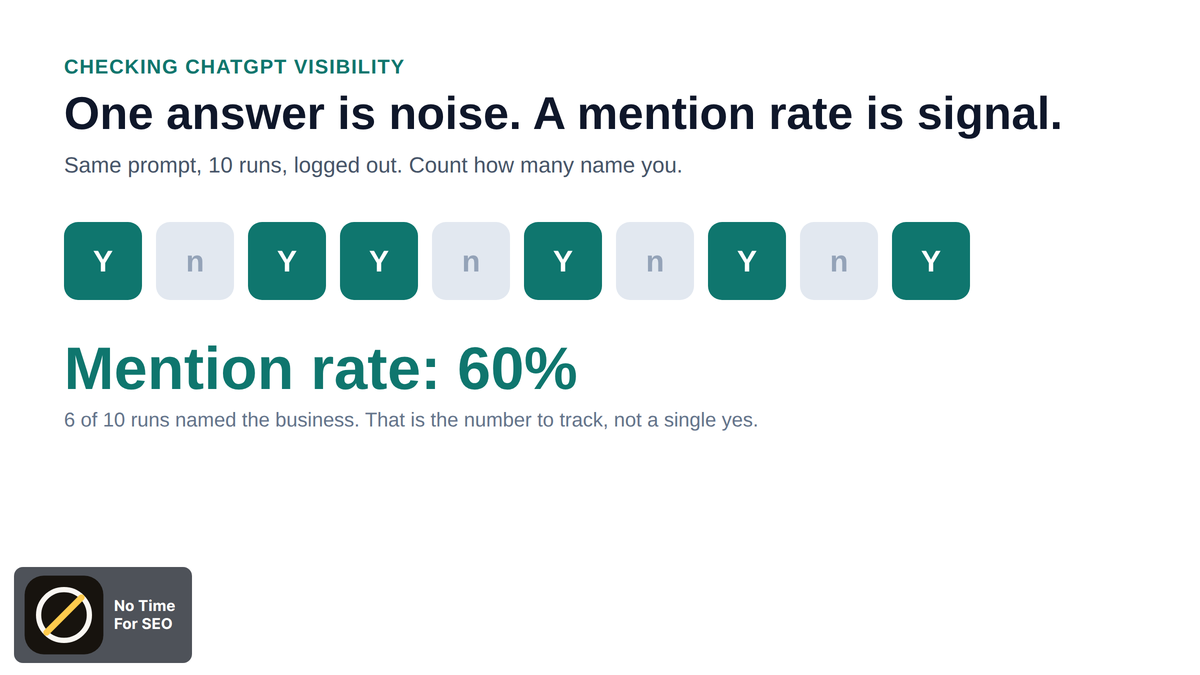
To check whether ChatGPT recommends your business, ask it the exact question a real buyer would type (like “best [service] in [city]”), run that same prompt 8 to 10 times in a fresh logged-out session, and count how many runs name you. That count divided by total runs is your mention rate. One lucky “yes” from a single run is noise, not a signal.
Most guides on this keyword are written by tools that want you to buy a tracker. This one is not. Below is the complete manual method you can run this afternoon for free, plus what our own server logs show about how often ChatGPT actually reads business pages.
Here is the number that reframes the exercise: across the 8 business sites No Time For SEO tracks in raw server logs, AI crawlers and agents made 39,695 hits in one week (the week of Monday July 6, 2026). Of those, 8,672 were live answer-time fetches from chatgpt-user, the agent ChatGPT sends to read a page when a real person asks a question.
How to check if ChatGPT recommends your business (the 10-minute manual method)
The manual check for ChatGPT visibility takes about 10 minutes and needs nothing but a browser. The goal is a mention rate, not a yes or no. Follow these steps exactly.
- Open a logged-out session. Use a private or incognito window, or log out of ChatGPT, so past chats and memory cannot bias the answer toward your own brand.
- Pick one buyer-intent prompt. Write the question a stranger would ask, phrased as a need, not your business name. Example: “best emergency dentist in Austin.”
- Run the exact same prompt 8 to 10 times. Start a new chat for each run. Do not paste follow-ups into one thread, because context inside a thread changes later answers.
- Log each run in a simple tally. For every run, mark three things: were you named, were you recommended and linked, and which competitor got named instead.
- Check the sources ChatGPT cites. When ChatGPT shows citations, note whether your domain is one of the source URLs it pulled from.
- Calculate your mention rate. Divide the runs that named you by total runs. Six out of ten is a 60% mention rate. Zero out of ten is a real answer too.
That is the entire core method. Everything below makes your result more accurate, harder to fool yourself with, and repeatable month over month.
Why does ChatGPT give a different answer every time you ask?
ChatGPT gives a different answer to the same prompt because it samples words probabilistically, not because it is broken. A setting called temperature adds controlled randomness, so a single check lies in both directions: one run can show a fluke, another can hide a business ChatGPT names 40% of the time.
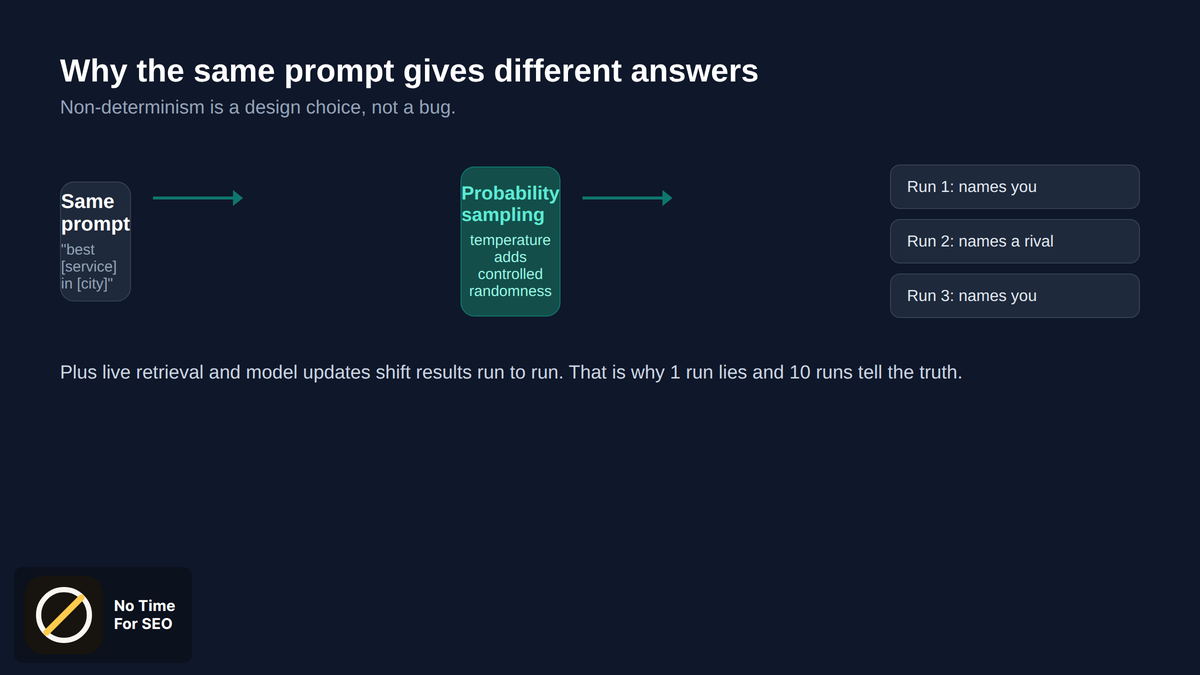
Two other forces move the answer between runs beyond sampling, and both are normal behavior rather than bugs:
- Live retrieval. When ChatGPT fetches fresh pages through its browsing agent, the sources it lands on can differ run to run.
- Model updates. OpenAI ships changes, so a mention rate from March is not a mention rate for July.
What prompts should you use to test if ChatGPT recommends you?
The prompts that test ChatGPT recommendation should be the real questions your buyers ask, spread across categories, comparisons, and problem-solution phrasing. Never test your own brand name. Build a small set of 10 to 20 prompts, because ChatGPT can surface you for “affordable” queries and miss you for “best” queries, and one prompt hides that split.
| Prompt type | Example wording | What it tests |
|---|---|---|
| Category | “best [service] in [city]” | Whether you surface for core discovery intent |
| Comparison | “[competitor] alternatives for [need]” | Whether you appear next to named rivals |
| Problem-solution | “how do I fix [problem] in [city]” | Whether you win the “who can help” moment |
| Recommendation | “who should I hire for [job] near me” | Whether ChatGPT actively recommends, not just lists |
| Qualifier | “most affordable [service] in [city]” | Whether specific buyer priorities surface you |
Test across engines too, because ChatGPT, Perplexity, Google AI Overviews, Gemini, and Claude are different systems that pull sources differently. A business Perplexity loves can be invisible in ChatGPT. Run your set in each one and score them separately. Never lump them together as “the AIs.”
How many times should you run each prompt to check your visibility?
Run each prompt at least 8 to 10 times to get a mention rate you can trust, and 20 times when the decision matters or the result sits near a boundary. The reason is sample size: with a random signal, a handful of runs has a wide margin of error, and three runs that split two-to-one could easily be a coin that is actually 50/50.
- Run 10 times for a routine monthly check. Good enough to catch big swings and track direction over time.
- Run 20 times when the answer is borderline. If your first 10 land around 4, 5, or 6 out of 10, add another 10 before you conclude anything.
- Treat 0 out of 10 and 10 out of 10 as real. Extremes stabilize fast. A clean zero or a clean ten rarely flips with more runs.
Should you check in incognito or logged in for accurate results?
Check your ChatGPT visibility in a logged-out or incognito session, never in your everyday logged-in account. A logged-in ChatGPT account with memory and chat history can quietly bias answers toward your own brand, because it remembers you run this business. That produces a false positive: ChatGPT names you for you, not for a stranger.
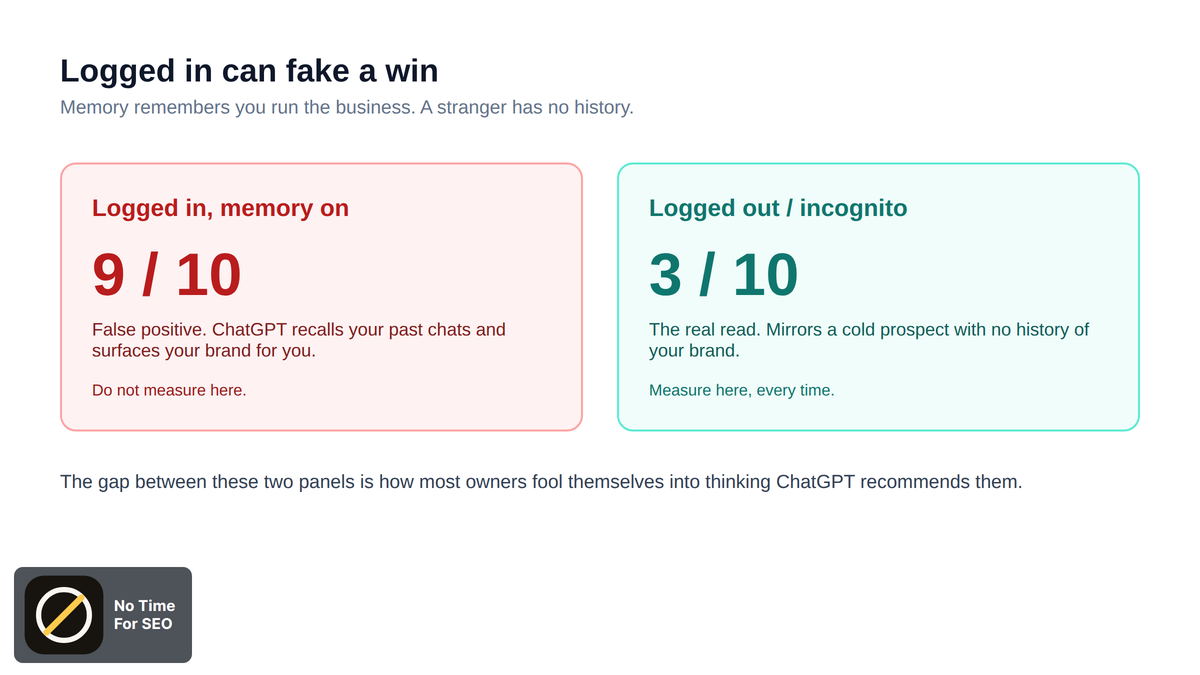
This is the single most common way owners fool themselves. You have typed your business name into ChatGPT dozens of times, memory picks that up, and then a cold prospect in a fresh session may never see the name you keep seeing.
- Turn off memory or use incognito. In ChatGPT, open a temporary chat or disable memory in settings before testing.
- Log out entirely for the strictest test. A logged-out session most closely mirrors a stranger with no history.
- Change nothing else between runs. Same account state, same region, same prompt wording, every time.
How do you measure your visibility score in ChatGPT?
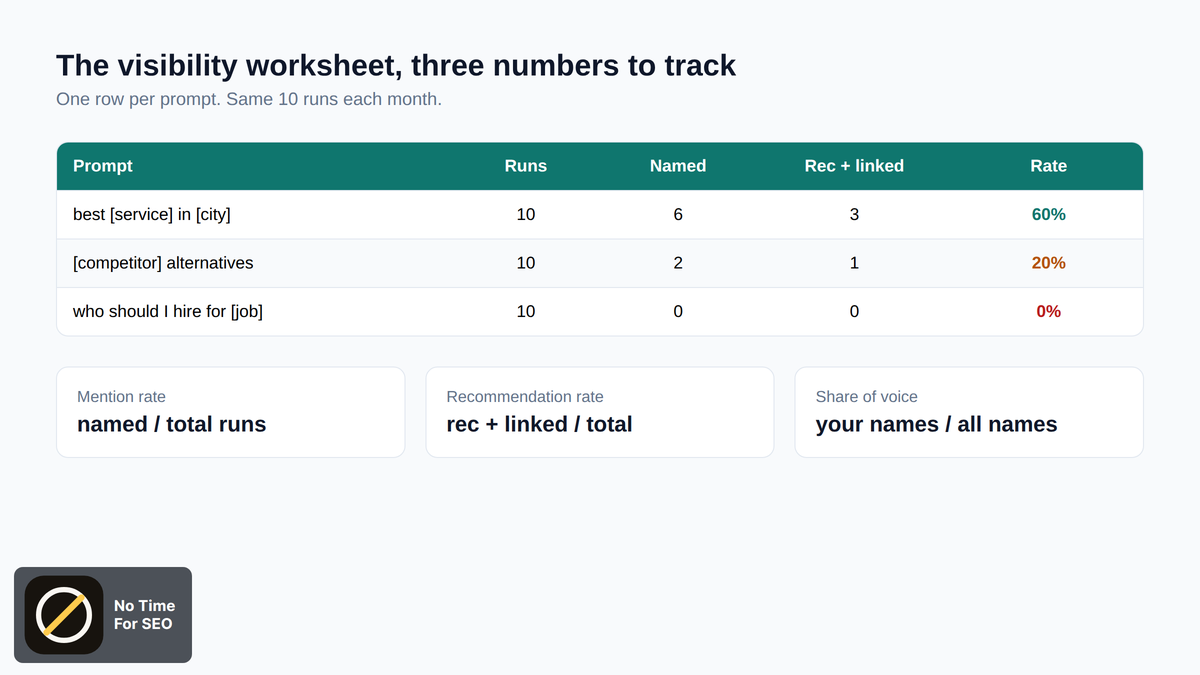
Measure your ChatGPT visibility as a mention rate and a share of voice across a logged run set, not as a single yes-or-no check. Mention rate is how many runs named you out of the total. Share of voice is how often you were named compared with every competitor named across the same runs. Log every run in one small worksheet so the score is repeatable next month.
| Prompt | Runs | Times named | Times recommended + linked | Mention rate | Top competitor named |
|---|---|---|---|---|---|
| best [service] in [city] | 10 | 6 | 3 | 60% | Competitor A |
| [competitor] alternatives | 10 | 2 | 1 | 20% | Competitor B |
| who should I hire for [job] | 10 | 0 | 0 | 0% | Competitor A |
Read the worksheet in three numbers. Your overall mention rate is total named runs divided by total runs. Your recommendation rate is the stricter figure: times recommended and linked, divided by total runs. Your share of voice is your names divided by all business names logged. Track all three monthly.
What our AI crawler logs show about how ChatGPT reads business pages
Across the 8 business sites No Time For SEO tracks in raw server logs, AI crawlers and agents made 39,695 hits in the week of Monday July 6, 2026. That is the real volume of machine reading happening on ordinary business sites right now, measured in nginx logs, not estimated.
| Crawler or agent | Hits, week of Mon Jul 6, 2026 | What it means |
|---|---|---|
| chatgpt-user | 8,672 | Live answer-time fetches: ChatGPT reading a page to answer a real person |
| ClaudeBot | 6,607 | Anthropic training and indexing crawl |
| GPTBot | 5,138 | OpenAI training crawl |
| PerplexityBot | 711 | Perplexity crawl |
| All AI crawlers + agents | 39,695 | Total AI machine reads across 8 tracked sites in one week |
The split matters for your mention rate. In that same week, chatgpt-user, the live answer-time agent, fetched pages 8,672 times, far more than PerplexityBot’s 711 and more than training crawlers like GPTBot at 5,138. If ChatGPT is not naming you, it is often not because it never read the space. It is because your page was not the one worth citing.
Can traditional rank trackers show your ChatGPT visibility?
Traditional rank trackers cannot show your ChatGPT visibility, because they measure a fixed, ranked list of blue links and ChatGPT produces a personalized, non-deterministic answer with no stable position. A tool built to report “you rank number 4 for [keyword]” has no number 4 to report inside a ChatGPT reply that reshuffles every run.
| Dimension | Traditional rank tracker | Manual ChatGPT check |
|---|---|---|
| What it measures | Fixed position for a keyword | Mention rate across many runs |
| Determinism | Stable day to day | Varies every run by design |
| Personalization | Mostly neutral | Biased by login, memory, region |
| Output | Ranked link list | Synthesized answer with some citations |
This does not mean traditional SEO stops mattering, because it still builds the pages and trust signals ChatGPT reads. One researched article No Time For SEO wrote for a 5-location dental group earned 52,171 Google impressions in one month while ranking on page one, measured in July 2026. That page is exactly the kind of asset a live ChatGPT read can land on and cite.
How to read a negative result and turn it into next steps
A ChatGPT visibility score of 0 out of 10 is a specific diagnosis, not a generic “improve your content” verdict. It means that when ChatGPT answered your buyer’s question, it chose other sources. Your next move depends on which of three failure points you hit, so check them in order.
- Check who got named instead of you and why. Read the competitors ChatGPT recommends and note what they have that you do not: a dedicated page for the exact query, reviews, third-party mentions.
- Check the source URLs ChatGPT cited. If it linked directory sites and review roundups, the fix is getting listed and mentioned there, not just editing your homepage.
- Check whether a page even answers the query. If no page on your site directly answers “best [service] in [city],” there is nothing for ChatGPT to cite. Build that page first.
Trust signals feed this. ChatGPT and Google AI Overviews lean on a complete Google Business Profile and independent third-party mentions when deciding who to surface for local intent. After our takeover, 53% of that dental group’s Google clicks came from non-branded searches, from people who did not know the practice name, measured across the top-100 query sample in July 2026.
Manual spot-checking versus automated AI-visibility tools
Manual spot-checking in the ChatGPT app is the right first move; automated GEO tools are for scale, not accuracy. GEO means generative engine optimization, the practice of tracking and improving how AI answer engines represent you. A tool runs hundreds of prompts across engines on a schedule so you do not click 200 times a month by hand.
- Manual checking is free, transparent, and enough to get a real answer, but it does not scale past a handful of prompts.
- Automated trackers scale and chart trends, but you pay, and you still cannot see ChatGPT’s internal ranking rules any more than a manual check can.
Our standing house line applies to both: anyone promising you a locked-in spot in ChatGPT answers is overselling. What you can do is measure honestly, publish the page that deserves the citation, and track the mention rate over time. As proof, a trading-education platform No Time For SEO runs search for has 82 of its top 100 keywords on page one of Google, with 63% of clicks non-branded, measured in July 2026.
Frequently asked questions
How do I know if ChatGPT recommends my business right now?
Open a logged-out ChatGPT session, ask the exact buyer question (“best [service] in [city]”), run it 10 times in fresh chats, and count how many name you. Six of ten is a 60% mention rate. One check is unreliable because ChatGPT answers vary every run by design.
Why does ChatGPT recommend a competitor and not me?
ChatGPT recommends the source it judged most citable for that query. Usually the competitor has a page answering the exact question, plus trust signals like a complete Google Business Profile, reviews, and third-party mentions. Read the citations ChatGPT shows to see which sources it pulled from.
Is checking ChatGPT visibility the same as checking my Google rank?
No. Google rank is a fixed position a rank tracker can report. ChatGPT visibility is a mention rate across many non-deterministic runs, biased by login and region. Traditional rank trackers cannot measure it. Strong Google rankings help your odds but do not guarantee ChatGPT names you.
How often should I re-check my ChatGPT visibility?
Run a monthly baseline of 10 runs per prompt, and re-check within a week of any major site change or new page launch. Keep the run count and prompt wording identical each time, or the mention rate is not comparable month to month.
Does asking ChatGPT about my own brand name count as a real test?
No. Asking “is [your business] good” only proves ChatGPT can read the name you typed. It says nothing about discovery. Test the need a stranger would type, like “best [service] in [city],” never your brand name, and always in a logged-out session.
Your do-this-now checklist for this week
- Write 10 buyer-intent prompts across category, comparison, problem-solution, recommendation, and qualifier wording. No brand names.
- Open a logged-out or incognito ChatGPT session so memory cannot inflate your score.
- Run each prompt 10 times in fresh chats and log named, recommended-and-linked, and top competitor for every run.
- Calculate your mention rate and share of voice using the worksheet table above.
- Read the citations to see whether your domain is a source ChatGPT pulls from.
- Repeat the exact set in Perplexity, Gemini, Claude, and Google AI Overviews and score each engine separately.
- For any 0 out of 10 prompt, build or fix the page that answers that exact query, then re-check next month.
Want your business named in answers like these?
Send us your website. In two business days you get a free, human written report on where you show up on Google and in AI answers, and what we would fix first.
Get your free audit →