How AI Chatbots Choose Which Business to Recommend
AI chatbots recommend the business they verify across the most sources with the least contradiction. 39,695 AI crawler fetches in one week across 8 sites.
AI chatbots recommend the business whose facts they can verify across the most independent sources with the least contradiction. They do not pick the “best” company in any human sense. They pick the one they are most confident describing correctly.
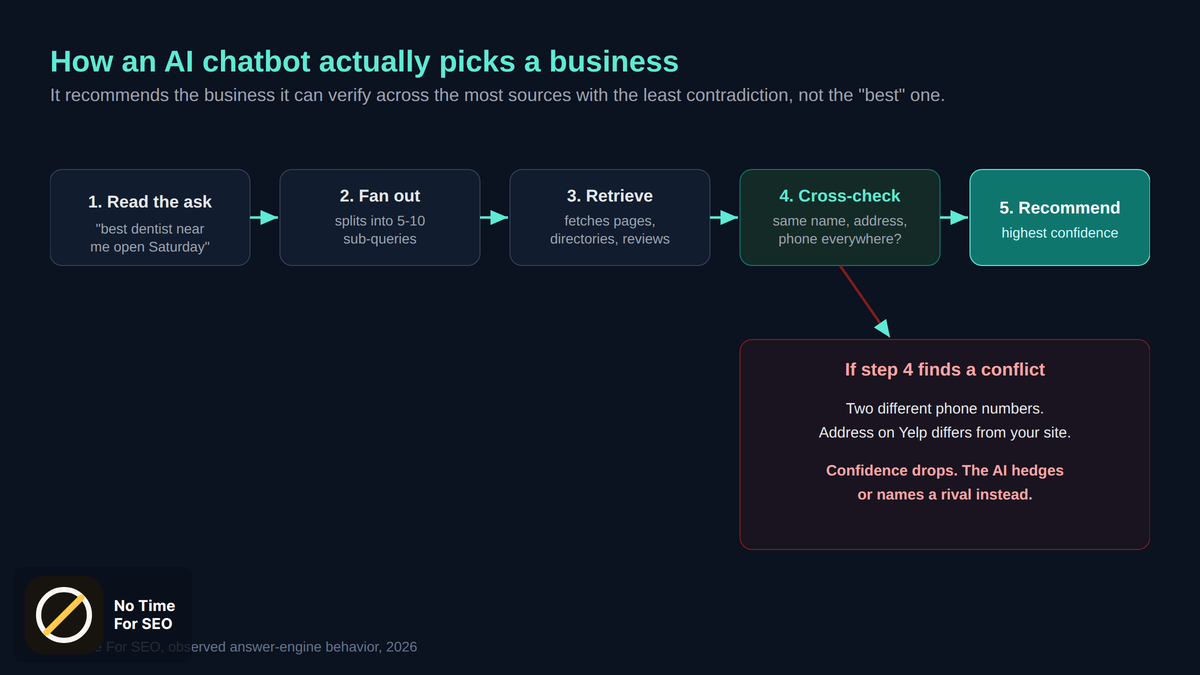
Across the 8 business sites No Time For SEO tracks in raw server logs, AI crawlers and agents made 39,695 fetches in a single week (week of Monday July 06, 2026). That traffic is the machine deciding whom it can trust.
- What this guide answers: which signals actually move an AI recommendation, and which ones do nothing.
- Where the numbers come from: our own nginx server logs and Google Search Console, plus one named external study.
- What you do this week: a concrete checklist a busy owner can finish in an afternoon.
One honest boundary before the mechanics: nobody outside OpenAI, Anthropic, or Google knows the exact ranking rules. What follows is observed behavior from our own logs and citation checks, not an insider claim.
What ranking factors do AI assistants use to pick a business?
AI assistants pick a business using verifiable trust signals, not marketing copy. The strongest signals are consistent name, address, and phone details across platforms, a spread of recent reviews, structured data the machine can read, presence in authoritative directories, and specific factual content on your own website.
| Signal the AI reads | What it is checking | Your move this week |
|---|---|---|
| NAP consistency | Same name, address, phone on every platform | Audit Google, Bing, Apple, Yelp for mismatches |
| Review profile | Volume, sentiment, recency, multi-platform spread | Ask 5 recent customers for a detailed review |
| Structured data | LocalBusiness and FAQPage schema it can parse | Add LocalBusiness schema to your homepage |
| Directory presence | Listing in trusted, industry-relevant directories | Claim your Bing Places and Apple Maps listings |
| Website specificity | Plain, factual, service-specific pages | Write one page per service with real detail |
| Third-party authority | Citations and links from trusted sources | Get listed on one respected industry site |
No single signal wins. The AI stacks these into a confidence score and recommends the highest-confidence match for the query. Standard Google ranking explains only a small share of AI citations: being in Google’s top ten gives roughly a one-in-four chance of showing up in an AI answer, per Search Engine Land’s 2025 reporting.
What the machine ignores
Notice what is missing from that table: ad spend, keyword density, and a slick homepage. Those move human clicks. They do not move a machine that is trying to confirm you are a real, consistent entity across the open web.
Does inconsistent name, address, and phone hurt my AI recommendations?
Yes. Inconsistent name, address, and phone details are one of the fastest ways to lose an AI recommendation. When ChatGPT or Perplexity reads about your business, it runs entity resolution: it tries to merge every mention it finds into one confident record.
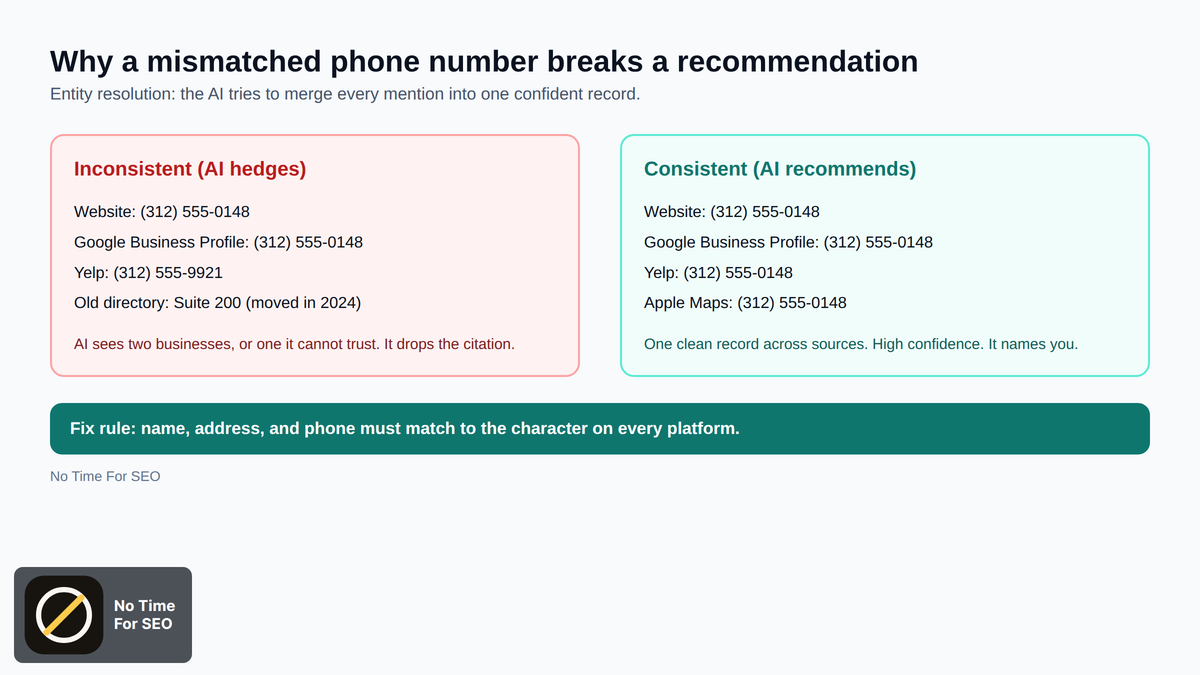
Two different phone numbers, or an old suite number on one directory, reads as either two businesses or one the model cannot trust. AI answers are built with retrieval, meaning the model fetches live sources and pulls facts from them. If those facts conflict, the safest move is to leave you out rather than state something it might get wrong.
To fix name, address, and phone consistency, work through this order:
- List every place your business is mentioned: Google Business Profile, Bing Places, Apple Maps, Yelp, industry directories, and your own website footer.
- Pick one canonical format for your name, address, and phone, down to “Suite” versus “Ste” and spacing.
- Correct each listing to match that exact format, one platform at a time.
- Search your business name plus any old phone number to find stale copies, and request removal or an update.
- Recheck in 30 days, since some directories cache old data for weeks.
How much do reviews matter for AI business recommendations?
Reviews matter a lot, but volume is the least important part. AI assistants weigh recency, sentiment detail, and multi-platform spread far more than a raw review count. A business with 40 detailed reviews from the last three months across Google and Yelp is a safer recommendation than one with 200 old five-star reviews on a single platform.
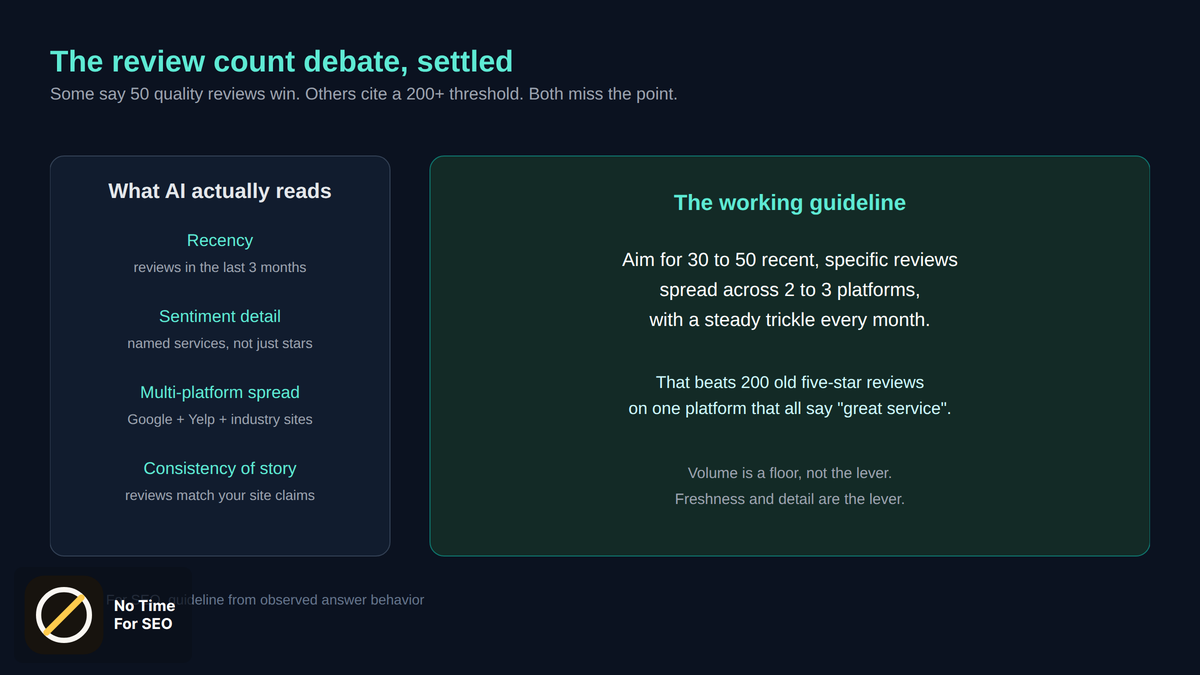
The advice online contradicts itself here. Some articles claim 50 quality reviews beat 200. Others cite a 100+ or 200+ review threshold. Both are guessing at a number. The defensible guideline, based on how these systems favor fresh, specific, corroborated data: aim for 30 to 50 recent reviews that name real services, spread across two or three platforms, with a steady trickle every month.
Why recency is the sharpest lever
A cluster of reviews from the last three months tells the AI your business is active and your reputation is current. A wall of reviews that stops 18 months ago reads as a business that may have declined or closed. Freshness signals liveness, and liveness raises confidence.
Do AI chatbots recommend businesses from directories or from websites?
AI chatbots use both, and they use them for different jobs. Directories like Google Business Profile, Bing Places, Apple Maps, and Yelp confirm that your business exists and that its core facts are consistent. Your own website supplies the detail: which services you offer, in what area, at what hours.
| Source type | Primary job in an AI answer | Example |
|---|---|---|
| Authoritative directory | Verify the entity exists and its facts match | Google Business Profile, Apple Maps, Yelp |
| Your website | Supply specific, service-level detail and FAQs | A dedicated “emergency plumbing” service page |
| Third-party authority | Corroborate reputation and trust | An industry association member listing |
| Review platforms | Provide recent, specific social proof | Fresh Google and Yelp reviews naming services |
This is why owners who only fix their website stay invisible in AI answers, and owners who only claim directories get verified but never recommended for specific needs. You need both halves: the directory is your ID card, the website is your resume.
FAQ pages get lifted straight into answers
FAQ-formatted content on your website is quoted directly by AI models, because the format matches how they structure a response. A page that asks “Do you offer same-day appointments?” and answers it in one clear sentence is easy for the machine to lift into its own answer.
How does brand mention frequency affect AI recommendations?
Brand mention frequency raises the odds an AI recommends you, because repeated, consistent mentions across independent sources are exactly the corroboration these systems look for. If you appear once, on your own site, the model has a single unverified claim. If you appear with the same facts on your site, in directories, in reviews, and on trusted third-party pages, it has many agreeing sources.
What our server logs actually measured
Across the 8 business sites No Time For SEO tracks, live answer-time fetches from chatgpt-user, the agent ChatGPT uses when it reads a page to answer a real person, hit 8,672 times in one week (week of Monday July 06, 2026). Those are not training crawls. That is the machine reading live to build an answer.
| AI user-agent | Fetches in one week | What it is doing |
|---|---|---|
| chatgpt-user | 8,672 | Live answer-time reads for real questions |
| ClaudeBot | 6,607 | Anthropic training crawl |
| GPTBot | 5,138 | OpenAI training crawl |
| PerplexityBot | 711 | Perplexity indexing crawl |
| All AI agents and crawlers | 39,695 | Total across the 8 tracked sites |
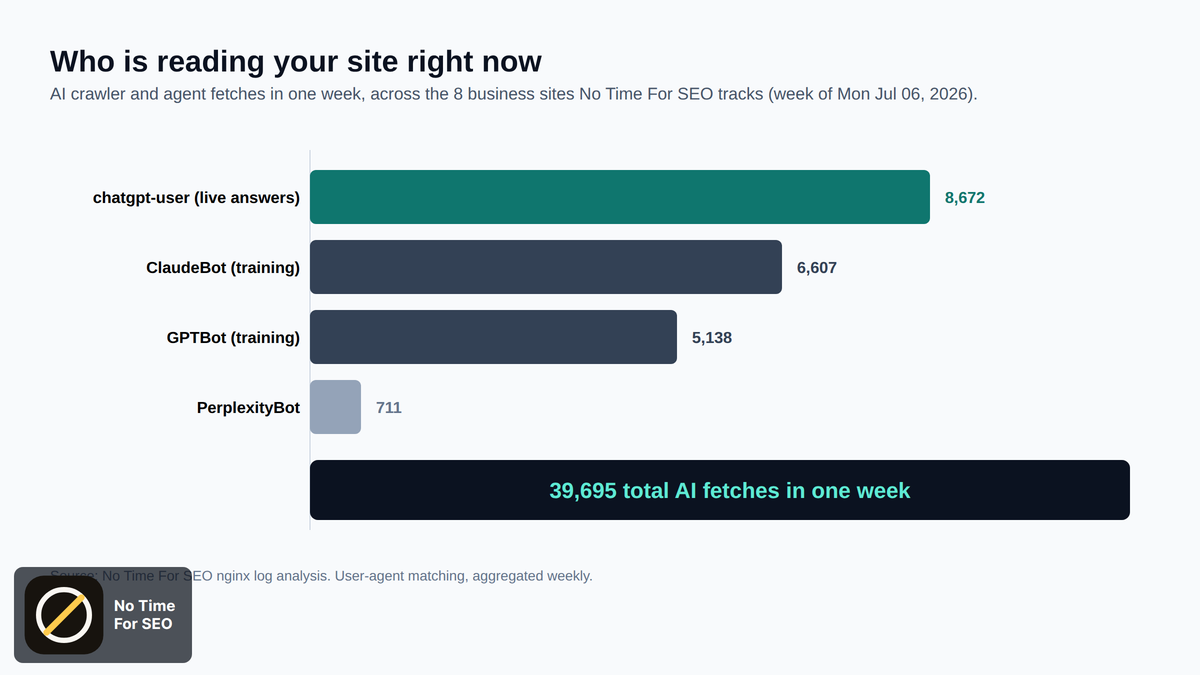
One honest caveat: heavy crawling is not the same as being recommended. A high fetch count means the machine is reading you. Whether it then cites you depends on the trust signals above. We measure the reading directly; the recommending, we infer from citation checks and client outcomes.
Can I pay to get my business recommended by ChatGPT?
No. You cannot pay OpenAI, Anthropic, or Perplexity to make ChatGPT, Claude, or Perplexity recommend your business in an organic answer. There is no “recommended business” ad slot inside the conversational answer today. Anyone selling you a promised AI recommendation or a locked-in citation is overselling, full stop.
One plain disclosure
Since this is what we do: No Time For SEO runs search and AI visibility for businesses, so we have a commercial interest in you caring about this. That does not change the mechanics. The work is the same whether you hire anyone or do it yourself: consistent facts, fresh specific reviews, readable structured data, and factual content.
How do ChatGPT, Perplexity, and Google AI Overviews differ in what they pull?
ChatGPT, Perplexity, and Google AI Overviews are different systems that lean on different data sources, so appearing in one does not mean appearing in another. ChatGPT blends its training data with live web reads through its browsing agent. Perplexity is retrieval-first, leaning heavily on live search results and citing sources inline. Google AI Overviews sits on top of Google’s own index and Google Business Profile data.
What our crawl logs show about each
Our logs show how uneven the attention is. In the same week across our 8 tracked sites, training crawlers hit us 11,745 times (GPTBot 5,138 and ClaudeBot 6,607), versus just 711 PerplexityBot hits. Perplexity reads far less aggressively for training, which fits its retrieval-first design. This is what we measured, not a claim about their internal design.
| System | Leans hardest on | Practical implication |
|---|---|---|
| ChatGPT | Training data plus live reads via its browsing agent | Both your published content and consistent facts matter |
| Perplexity | Live retrieval, cites sources inline | Fresh, clearly-sourced pages get quoted |
| Google AI Overviews | Google’s index and Google Business Profile | Traditional local SEO and a strong profile help most |
| Google Gemini | Google ecosystem plus live search | Overlaps with AI Overviews signals |
The takeaway: do not optimize for “the AI”. Optimize for verifiable, consistent facts, because that is the common denominator across every one of these systems.
Does ranking on page one of Google guarantee an AI recommendation?
No. Ranking on page one of Google does not guarantee an AI recommendation, because AI recommendation and traditional local SEO are different channels with different signals. You can hold a top-three Google position and still be absent from a ChatGPT answer if your facts conflict across sources or your reviews have gone stale.
What the payoff looks like when the work is done right
Strong organic performance and clean facts tend to travel together. A single researched article No Time For SEO wrote for a 5-location dental group earned 52,171 Google impressions in one month while ranking on page one (measured July 2026).
| Client (anonymized) | Result measured | Non-branded share |
|---|---|---|
| 5-location dental group | 52,171 Google impressions in one month, page-one article | 53% of clicks non-branded |
| Trading-education platform | 82 of top 100 keywords on page one of Google | 63% of clicks non-branded |
After our takeover, 53% of that dental group’s Google clicks came from non-branded searches: people who did not know the practice name (top-100 query sample, July 2026). Non-branded strength is the tell that a business is being found by people describing a need, which is the exact moment an AI assistant is trying to answer.
The same pattern on a very different business
A trading-education platform No Time For SEO runs search for has 82 of its top 100 keywords on page one of Google, and 63% of its clicks are non-branded (July 2026). Our foundational content approach is laid out in our getting-started guide.
What should a brand-new business with no reviews or citations do first?
A brand-new business should solve the cold-start problem in a fixed order: establish a verifiable identity before chasing visibility. With zero review or citation history, an AI has nothing to corroborate, so it will skip you rather than risk a wrong recommendation. AI systems would rather hedge or name an established competitor than vouch for a business they cannot verify.
Work this sequence in your first month:
- Claim your Google Business Profile, Bing Places, and Apple Maps listings with identical name, address, and phone.
- Publish a simple website with one factual page per service, plus a short FAQ that answers real customer questions.
- Add LocalBusiness schema to your homepage and FAQPage schema to your FAQ, so the facts are machine-readable.
- Earn your first 10 to 15 reviews from real customers who name the specific service they received.
- Get one listing on a respected industry directory or association to add a trusted third-party mention.
This is the whole game for a new business: become an entity that agrees with itself everywhere it appears. Once the facts line up across four or five independent sources, the AI has the corroboration it needs to start recommending you.
Your do-this-now checklist for this week
Here is the short list a busy owner can finish this week to become the business an AI can confidently recommend:
- Audit your name, address, and phone across Google Business Profile, Bing Places, Apple Maps, and Yelp, and fix every mismatch to one exact format.
- Search your business name plus any old phone number, then request removal of stale listings.
- Ask five recent customers for a review that names the specific service they used.
- Add LocalBusiness schema to your homepage and FAQPage schema to your FAQ page.
- Write one plain, factual page for each core service, with a short FAQ underneath.
- Claim one listing on a trusted industry directory to add a third-party mention.
Frequently asked questions
How do AI chatbots choose which businesses to recommend?
AI chatbots recommend the business whose facts they can verify across the most independent sources with the least contradiction. They decompose the question, retrieve live sources, cross-check your name, address, and phone against directories and reviews, then recommend the highest-confidence match. Verifiable consistency beats marketing polish every time.
What ranking factors do AI assistants use to pick a business?
AI assistants weigh NAP consistency across platforms, review recency and detail, structured data they can read, presence in authoritative directories, specific website content, and third-party citations. No single factor decides it. The systems stack these into a confidence score and recommend the highest-confidence match for the query.
How much do reviews matter for AI business recommendations?
Reviews matter a lot, but recency, sentiment detail, and multi-platform spread matter more than raw volume. Aim for 30 to 50 recent reviews that name specific services across two or three platforms, refreshed monthly. That beats 200 old, generic five-star reviews on a single platform.
Can I pay to get my business recommended by ChatGPT?
No. There is no paid slot to make ChatGPT, Claude, or Perplexity recommend your business in an organic answer. Anyone promising an AI recommendation or citation is overselling. You earn recommendations by building verifiable trust signals: consistent facts, fresh specific reviews, and machine-readable content.
Does inconsistent name, address, and phone hurt my AI recommendations?
Yes. Inconsistent name, address, and phone details break the entity resolution AI systems run to merge your mentions into one trusted record. Conflicting facts, such as two phone numbers or a stale address, lower the model’s confidence, so it hedges or recommends a competitor whose facts line up cleanly.
Do AI chatbots recommend businesses from directories or from websites?
Both. Directories like Google Business Profile and Apple Maps verify that your business exists and its facts are consistent. Your website supplies service-level detail and FAQs the AI can quote. You need both: the directory is the ID card, the website is the resume.
How does brand mention frequency affect AI recommendations?
Repeated, consistent brand mentions across independent sources give AI systems the corroboration they need to recommend you with confidence. Appearing once on your own site is a single unverified claim. Appearing with matching facts on your site, in directories, in reviews, and on trusted third-party pages is strong corroboration.
Want your business named in answers like these?
Send us your website. In two business days you get a free, human written report on where you show up on Google and in AI answers, and what we would fix first.
Get your free audit →