How to Get Your Business Mentioned in ChatGPT
No Time For SEO logged 8,672 live ChatGPT fetches in one week across 8 sites. The owner step-by-step playbook to get your business mentioned in ChatGPT.
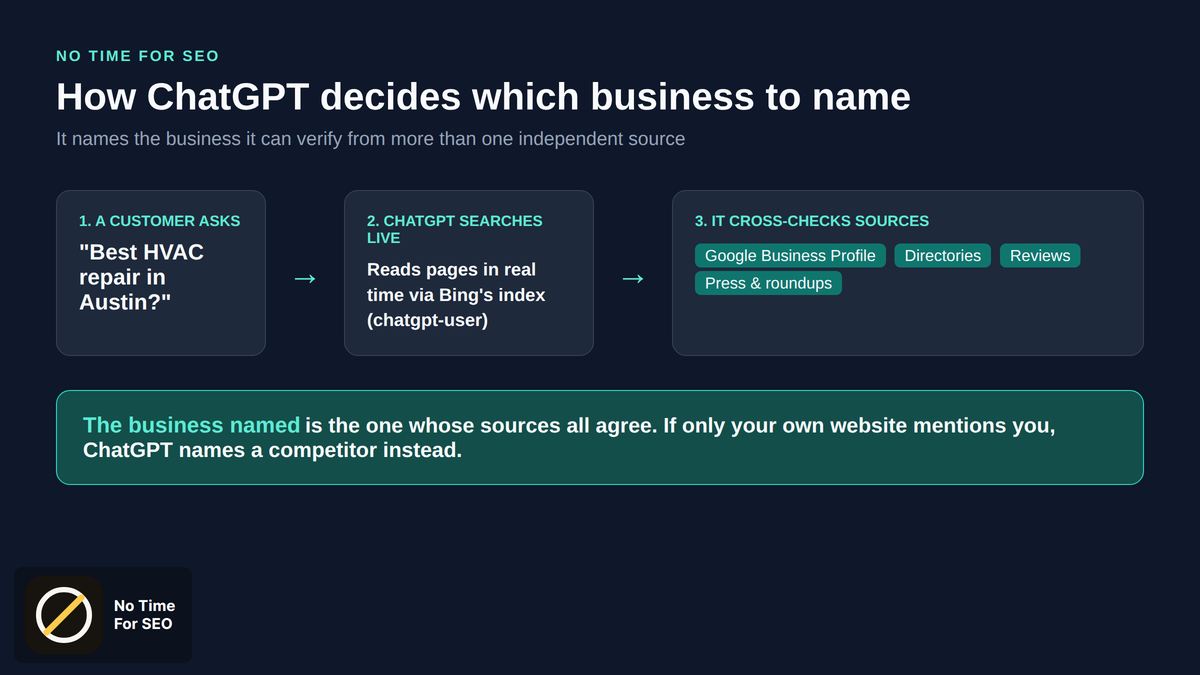
ChatGPT mentions the businesses it can verify from more than one independent source. If your business only lives on your own website, ChatGPT has nothing to cross-check, so it names a competitor that directories, review platforms, and articles all describe the same way. That is the whole mechanic, and a solo owner can fix it without a marketing team.
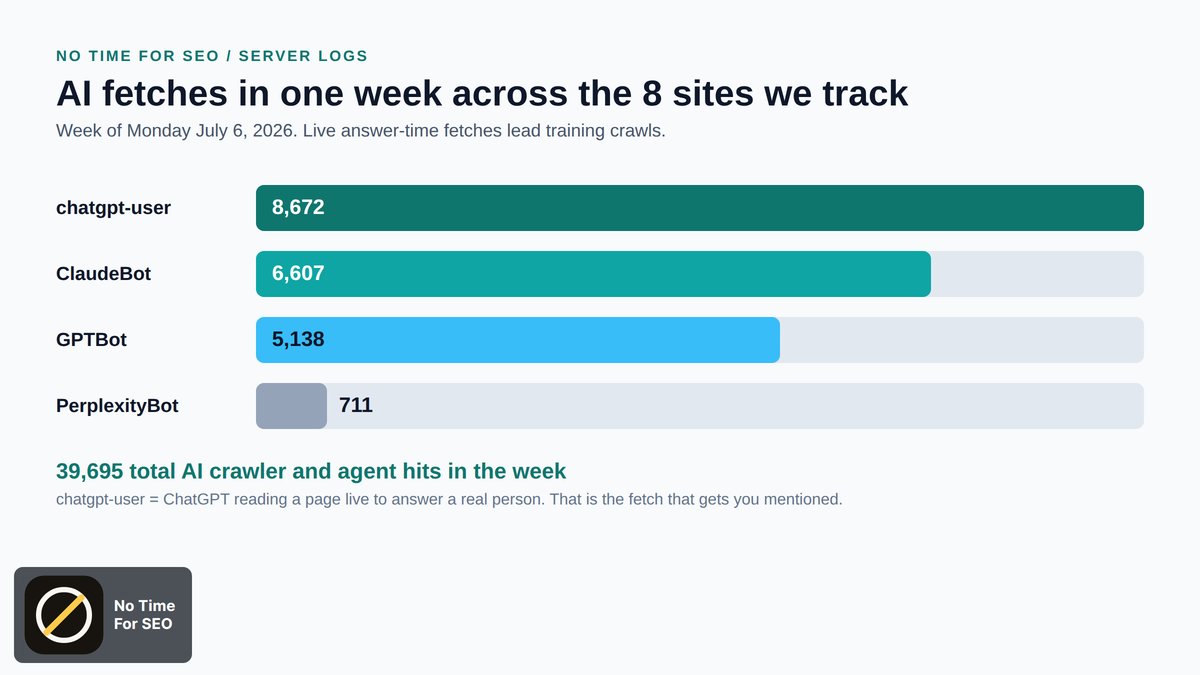
No Time For SEO reads raw web server logs for the 8 business sites we track. In the week of Monday July 6, 2026, those sites took 39,695 AI crawler and agent hits. Of those, 8,672 came from chatgpt-user, the agent ChatGPT sends when it reads a page live to answer a real person.
This guide is the owner-to-owner playbook, not an agency pitch. You get the exact prompts to test your current visibility, copy-paste schema code, a realistic timeline, and a checklist to run this week. Every number here comes from our own server logs, from Google Search Console, or from a named source.
Does ChatGPT pull business recommendations from live web search or training data?
ChatGPT pulls business recommendations from two places, and for local questions live web search does most of the work today.
- Training data: a static snapshot frozen months ago. It lets ChatGPT describe well-known national brands without searching, but a new or local business rarely sits inside it.
- Live web search: ChatGPT reads pages in real time through Bing’s index before answering. This is where a small business actually gets picked up, and it leaves a fingerprint in your server logs.
Here is what that fingerprint looked like for one week across the 8 sites we track. ChatGPT’s live answer-time agent, chatgpt-user, fetched pages far more than any training crawler, which tells you live search is doing the heavy lifting.
| User-agent | What it does | Fetches in the week |
|---|---|---|
| chatgpt-user | ChatGPT reading a page live to answer a person | 8,672 |
| ClaudeBot | Anthropic training crawl (Claude) | 6,607 |
| GPTBot | OpenAI training crawl (future models) | 5,138 |
| PerplexityBot | Perplexity crawl | 711 |
| All AI crawlers and agents combined | 39,695 | |
Takeaway: across the 8 sites we track, live answer-time fetches from chatgpt-user (8,672) outnumbered OpenAI’s training crawler GPTBot (5,138) in the same week, so the page ChatGPT reads when a customer asks is your live page, not a cached memory.
The practical lesson is blunt: ChatGPT reads your live site. If that page is slow, blocked, or thin, ChatGPT drops it and reads a competitor instead. We keep our tracked pages returning in well under half a second for exactly this reason.
Why does ChatGPT not mention my business when I ask about my industry?
ChatGPT does not mention your business when it cannot confirm what you do from sources other than your own website. A single self-published claim is not enough for ChatGPT to stake a recommendation on. It wants agreement across directories, review sites, and articles before it puts your name in an answer.
- No third-party footprint: your business exists only on your own domain, so nothing corroborates it.
- Inconsistent NAP: your name, address, and phone number disagree across listings, so no source clearly matches another.
- No plain statement of what you do: your website never says, in extractable sentences, exactly what you sell and who you serve.
Entity clarity is the fix for the third gap. Entity clarity means it is unambiguous what your business is, what it sells, and where it operates. If a human skimming your homepage cannot say in one sentence what you do and who for, ChatGPT cannot either.
What makes ChatGPT recommend one local business over another?
For local businesses, ChatGPT recommends the option with the clearest, most consistent, most corroborated public record. Two shops can be equally good in real life, and ChatGPT names the one whose Google Business Profile, directory listings, and reviews all line up and say the same thing.
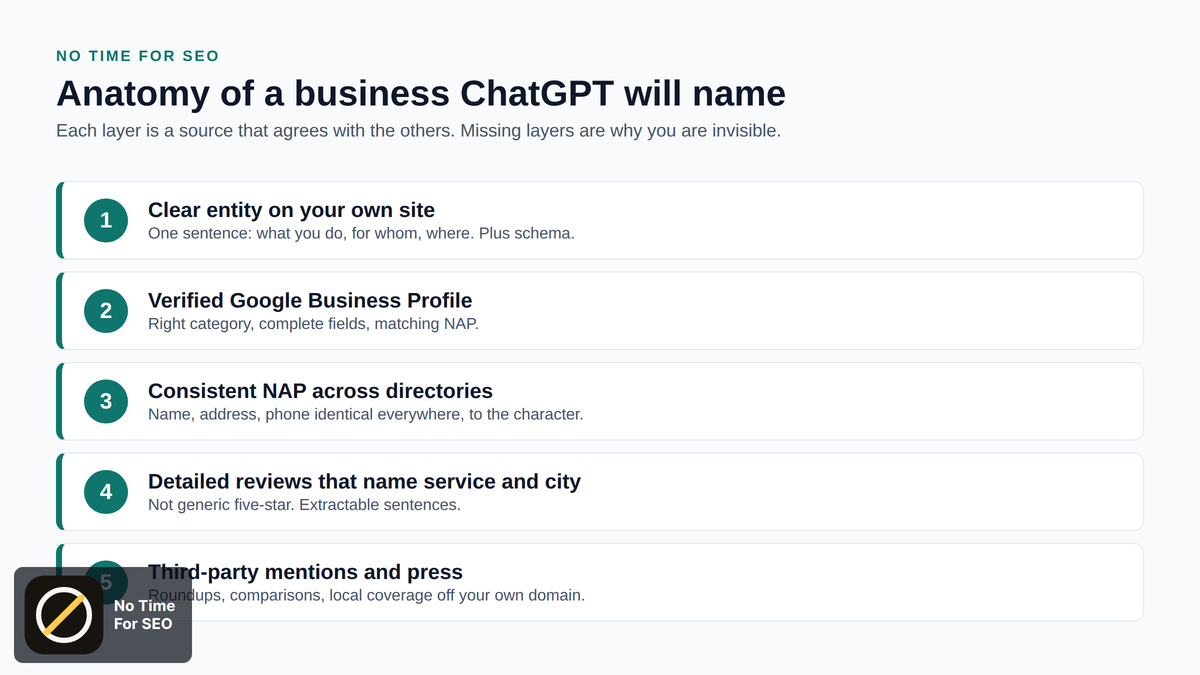
Google Business Profile is the anchor for local visibility. It feeds Google’s local data, which flows into the directories and maps that AI systems read. An unverified or half-filled profile is the single most common reason a real local business is invisible to AI answers.
- Claim and verify the listing so you control it, not an auto-generated stub.
- Set the exact primary category that matches what a customer would type, not a vague one.
- Fill every field: hours, service area, services, attributes, and a description using your one-sentence entity statement.
- Match your NAP so the name, address, and phone number are identical to your website, to the character.
- Post and reply regularly so the profile reads as active, not abandoned.
NAP consistency deserves its own line. Keep your name, address, and phone number identical across every directory and listing. “Suite 200” on one site and “Ste 200” on another can be read as two different places, which splits your evidence and weakens every source at once.
How do third-party mentions affect whether ChatGPT names my business?
Third-party mentions are the strongest lever a small business has for ChatGPT visibility. A mention is any place other than your own site that describes your business, and ChatGPT treats agreement across these as evidence you are real and relevant.
- A directory or listing site
- A review platform
- A news article or local press piece
- A “best [service] in [city]” roundup
- A comparison or alternatives post
This is corroboration, not link-building. The old SEO goal was link authority; the AI goal is consensus, meaning many independent sources describing you the same way. One trade-directory listing plus two roundups plus consistent reviews can outweigh a single strong link, because ChatGPT is checking whether the web agrees about you.
- List on the core directories for your category and city, with identical NAP every time.
- Earn roundup and comparison inclusions (“best [service] in [city]”) by pitching the writers who publish them.
- Get press and PR coverage from local outlets and niche industry blogs, even small ones.
- Publish expert content elsewhere: a guest guide, a podcast, or a genuinely useful forum answer.
We see the payoff of corroborated, well-covered content in Google data too, which is the same open web ChatGPT reads. One researched article we wrote for a 5-location dental group earned 52,171 Google impressions in a single month while ranking on page one, measured in July 2026 from that page’s Search Console report.
Do I need reviews on Yelp and G2 for ChatGPT to recommend me?
You do not strictly need Yelp or G2, but reviews on the platforms that matter for your category make ChatGPT far more confident naming you. Reviews are third-party corroboration with sentiment attached, so pick the platforms your customers actually use.
- Local service business: Google and Yelp reviews carry the most weight.
- Software or B2B: G2 and Capterra are the platforms ChatGPT leans on.
- Restaurants and hospitality: Google, Yelp, and TripAdvisor.
Detailed reviews outperform generic five-star reviews for AI visibility. “Great service, five stars” gives ChatGPT nothing to extract. “They repaired our commercial HVAC in Austin the same day and explained the fix” names the service, the city, and the outcome, which is exactly the kind of sentence an AI can lift into an answer.
| Attribute | Generic five-star review | Detailed review |
|---|---|---|
| Extractable facts | None | Service, location, outcome |
| Entity reinforcement | Weak | Repeats what you do and where |
| Answers a real question | No | Yes (“who fixes X in [city]”) |
| Value to ChatGPT | Low | High |
Takeaway: ask happy customers to name the specific service and the city in their review, because a review that states what you did and where is worth more to ChatGPT than ten reviews that only say “five stars.”
Add schema markup so ChatGPT can extract your facts
Schema markup is code that states your business facts in a format machines read directly, so nothing has to be inferred from prose. It is also called structured data or JSON-LD. Most guides tell you to add it and never show the code, so here is a copy-paste LocalBusiness block; replace the values with yours.
<script type="application/ld+json">
{
  "@context": "https://schema.org",
  "@type": "LocalBusiness",
  "name": "Acme HVAC Repair",
  "description": "Commercial and residential HVAC repair in Austin, Texas.",
  "url": "https://www.acmehvac.com",
  "telephone": "+1-512-555-0142",
  "address": {
    "@type": "PostalAddress",
    "streetAddress": "200 Congress Ave, Ste 200",
    "addressLocality": "Austin",
    "addressRegion": "TX",
    "postalCode": "78701",
    "addressCountry": "US"
  },
  "areaServed": "Austin, TX",
  "openingHours": "Mo-Fr 08:00-18:00",
  "priceRange": "$$"
}
</script>
Install it in three steps a non-technical owner can do without help.
- Edit the values so the name, address, and phone match your Google Business Profile exactly.
- Paste it into your site: in WordPress use a plugin’s schema field or a header-scripts box; on Squarespace or Wix use a code block or the site-wide code injection area.
- Validate it by running the live URL through Google’s Rich Results Test and confirming the LocalBusiness fields read back correctly.
Schema does not force ChatGPT to name you. It removes ambiguity, which is a real edge when your data is otherwise clean and consistent. Add it once, keep it matching your other listings, and move on.
Write content in a direct-answer format ChatGPT can lift
Write so a single sentence answers a real question with no surrounding context needed. AI systems extract standalone sentences and attribute them, so a direct-answer sentence at the top of a section hands ChatGPT something it can quote, while a long narrative buries the answer.
- Lead with the answer in the first sentence, then explain.
- Keep paragraphs short and use bullet points where you can.
- Make the heading match how a customer would actually ask the question.
This is BLUF: bottom line up front. Compare the two styles below and write everything customer-facing in the right-hand column.
| Narrative (hard to extract) | Direct-answer (easy to extract) |
|---|---|
| “Over the years we have proudly served the greater Austin community with a range of climate solutions…” | “Acme HVAC Repair fixes commercial and residential HVAC in Austin, Texas, usually same-day.” |
| Answer buried mid-paragraph | Answer is the first sentence |
| Marketing voice | Plain factual voice |
Takeaway: lead every service page and FAQ answer with the plain factual sentence you want ChatGPT to repeat, because the sentence it can lift cleanly is the sentence it cites.
Build topical authority while you are at it
Topical authority comes from dedicated guides that answer the real questions in your field with specifics only an operator would know. That is E-E-A-T in practice: experience, expertise, authoritativeness, and trust, shown through content rather than claimed. Our own approach is written up in our notes on getting found in AI search.
Test whether your business shows up in ChatGPT today
Test your current visibility by running a fixed set of prompts in ChatGPT and recording whether you are named. No ranking guide gives you a repeatable list, so here is one. Run each prompt in ChatGPT with web search on, then note yes or no and any competitor named instead.
| # | Prompt to paste into ChatGPT | What it checks |
|---|---|---|
| 1 | “Best [your category] in [your city]?” | Whether you appear in the core local list |
| 2 | “Who should I hire for [specific service] near [city]?” | Service-level visibility |
| 3 | “Tell me about [your exact business name].” | Whether ChatGPT knows you at all |
| 4 | “Compare [you] and [a competitor].” | What sources it has on you |
| 5 | “What do reviews say about [your business name]?” | Whether your reviews are being read |
Takeaway: save the answers to prompts one through five with today’s date, because the only honest way to know if your work is landing is to compare the same five prompts month over month.
How long does it take for ChatGPT to start mentioning a new business?
Expect weeks to a few months, not days, before a new business starts appearing in ChatGPT answers, and be honest that it may not happen at all if the corroboration never gets built. Nobody outside OpenAI can quote you a fixed number, so what follows is our observed pattern, labeled as belief where it is belief.
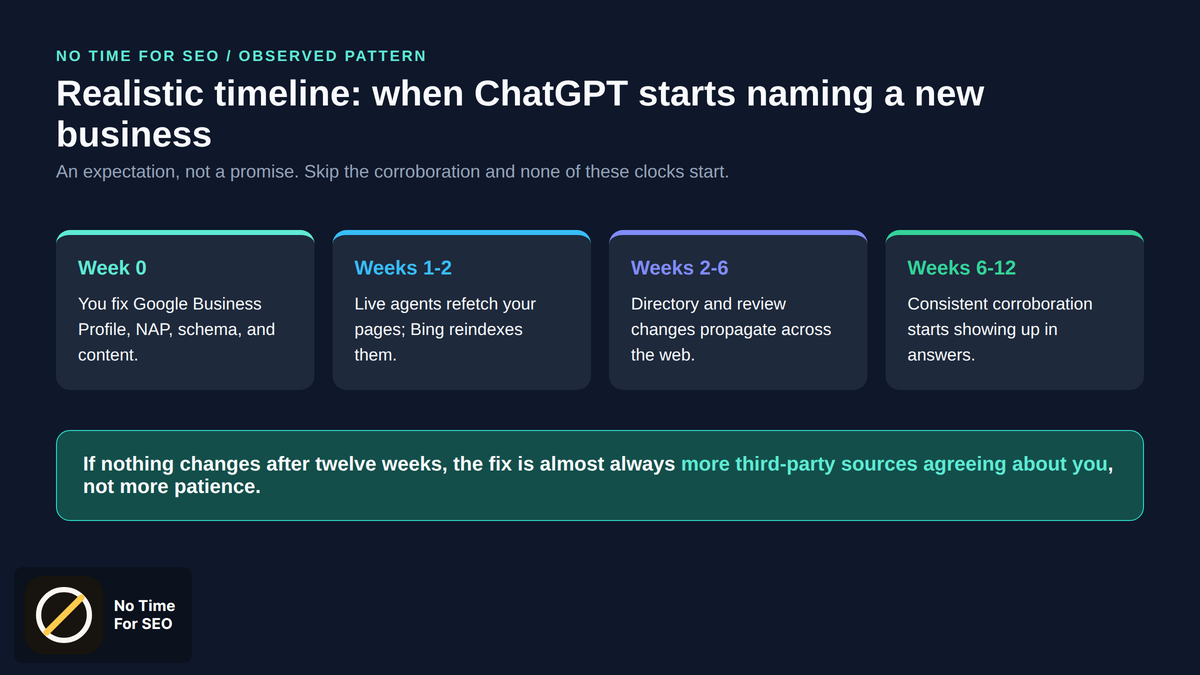
The timeline below is a realistic expectation, not a promise. It assumes you actually do the work: Google Business Profile, NAP consistency, directory listings, reviews, schema, and a few third-party mentions. Skip the corroboration and none of the clocks below start.
| Timeframe | What is happening |
|---|---|
| Week 0 | You fix Google Business Profile, NAP, schema, and content. |
| Weeks 1 to 2 | Live agents refetch your pages; Bing reindexes them. |
| Weeks 2 to 6 | Directory and review changes propagate across the web. |
| Weeks 6 to 12 | Consistent corroboration starts showing up in answers. |
Takeaway: plan for a six to twelve week horizon, and if nothing has changed after that window, the problem is almost always too few third-party sources agreeing about you, not a delay.
What to do if nothing changes after weeks of effort
Rerun the prompt test, then check the corroboration. Are you on the main directories with identical NAP? Do you have detailed reviews naming the service and city? Are there any mentions off your own domain at all? Missing corroboration, not patience, is the usual fix.
Traditional SEO versus generative and answer engine optimization
Traditional SEO earns clicks from a ranked list; generative and answer engine optimization earns a mention inside a written answer. GEO (generative engine optimization) and AEO (answer engine optimization) are two names for the same goal: being the source an AI quotes.
| Dimension | Traditional SEO | GEO / AEO |
|---|---|---|
| Goal | Rank in the list of links | Be named in the answer |
| Unit of success | A click | A citation or mention |
| Key signal | Links and rankings | Corroboration across sources |
| Content shape | Keyword-optimized pages | Extractable, direct-answer statements |
| How content is read | Crawled and indexed | Fetched live at answer time |
Strong fundamentals compound on the open web ChatGPT reads. A trading-education platform we run search for has 82 of its top 100 keywords on page one of Google, and 63% of its clicks are non-branded, measured across the top-100 query sample for the 28-day window ending July 12, 2026. The same footprint that wins those rankings is what AI systems read when they answer.
The same fixes largely work for Claude, Gemini, and Perplexity
The corroboration you build for ChatGPT also helps Claude, Google’s Gemini and AI Overviews, and Perplexity, because they all reward the same thing: a consistent, well-covered public record. They are different systems that behave differently, so a mention in one does not guarantee a mention in all.
| System | Where it mainly sources answers | Its crawler in our logs that week |
|---|---|---|
| ChatGPT | Live web via Bing’s index, read at answer time | chatgpt-user: 8,672 live fetches |
| Claude | Its own crawl plus live web | ClaudeBot: 6,607 |
| Perplexity | Live web with sources cited visibly | PerplexityBot: 711 |
| Google AI Overviews | Google’s own index and local data | Googlebot (not in this AI-agent sample) |
Takeaway: do not lump these systems together, because ChatGPT leans on Bing’s live index while Google AI Overviews lean on Google’s own index and established local data, and the exact behavior differs even though the underlying fixes overlap.
Where these numbers come from
Every number in this guide is measured, not modeled. Here is the provenance so you can weigh it honestly.
- Crawler figures: raw nginx server logs across the 8 business sites No Time For SEO tracks, matched by user-agent (GPTBot, ClaudeBot, PerplexityBot, chatgpt-user, and others) and aggregated for the week of Monday July 6, 2026.
- Google figures: each client’s Google Search Console page and query reports, verified in July 2026 over a 28-day window, with client names kept anonymous and full data available on request.
These are what we measured on the sites we manage. They are honest scope, not a guarantee of your results.
Your do-this-now checklist for this week
Run this in order. Each step is something a busy owner can finish without a marketing team, and together they build the corroboration ChatGPT looks for.
- Run the five test prompts in ChatGPT with web search on and save the answers with today’s date.
- Write your one-sentence entity statement and put it on your homepage and Google Business Profile.
- Claim and complete your Google Business Profile, with the exact category and matching NAP.
- Fix NAP everywhere: make name, address, and phone identical across every directory and listing.
- Paste the LocalBusiness schema onto your site and validate it in Google’s Rich Results Test.
- Rewrite your homepage and top service page to lead with plain, extractable answer sentences.
- Ask three recent happy customers for a review that names the service and the city.
- Get one new third-party mention: a directory listing, a roundup pitch, or a local press note.
- Read our companion notes on getting found in AI search and pick your next mention target.
- Rerun the five prompts in six weeks and compare, then in twelve weeks again.
Full disclosure in one sentence: No Time For SEO does this work for clients, which is why we have server logs and Search Console data to share, and the playbook above is the same one we run.
Frequently asked questions
Can I pay ChatGPT to mention my business?
No, you cannot pay OpenAI to have ChatGPT recommend your business in organic answers. There is no ads slot inside a normal recommendation. Visibility comes from corroboration: a verified Google Business Profile, consistent NAP, reviews, schema, and third-party mentions that agree about what you do.
Does blocking AI crawlers hurt my ChatGPT visibility?
Blocking chatgpt-user in your robots.txt or firewall can stop ChatGPT from reading your pages live to answer questions, which is the exact fetch that gets you mentioned. Blocking GPTBot only opts you out of future training crawls. If you want ChatGPT mentions, do not block chatgpt-user.
How do I check if ChatGPT is reading my website?
Check your server access logs for the user-agents chatgpt-user, GPTBot, ClaudeBot, and PerplexityBot. A chatgpt-user hit means ChatGPT fetched that page live to answer someone. Across the 8 sites No Time For SEO tracks, chatgpt-user made 8,672 such fetches in the week of July 6, 2026.
Is getting mentioned in ChatGPT different for a local business than a national brand?
Yes. National brands often already sit in ChatGPT’s training data, so they appear without live search. A local business is won on Google Business Profile, NAP consistency, local directories, and reviews, which is where a solo owner can act fastest and see change in weeks, not years.
What is the single most important step to get mentioned in ChatGPT?
Build third-party corroboration: get described the same way across your Google Business Profile, directories, reviews, and at least a few mentions off your own domain. ChatGPT names businesses it can verify from more than one independent source, so agreement across the web is the single most effective move.
Will these fixes also help me show up in Google AI Overviews and Perplexity?
Largely yes, because Google AI Overviews and Perplexity reward the same consistent, well-covered public record. They are different systems with different behavior, so test each separately, but the underlying work of clear entity data, reviews, schema, and third-party mentions overlaps heavily across all of them.
Want your business named in answers like these?
Send us your website. In two business days you get a free, human written report on where you show up on Google and in AI answers, and what we would fix first.
Get your free audit →