Why ChatGPT Doesn’t Know Your Business Exists
ChatGPT read pages 8,672 times in one week across the 8 sites No Time For SEO tracks. Here is why ChatGPT ignores your business and the one-week fix.
ChatGPT does not know your business exists because it builds its picture of a company from what the wider web says about that company, not from your website alone. Your business has probably not built enough consistent third-party mentions yet for ChatGPT to treat it as a known, described entity.
That is the short version. Here is a number most articles cannot give you. In the week of Monday, July 6, 2026, ChatGPT’s live-reading agent fetched pages 8,672 times across the 8 business sites No Time For SEO tracks in raw web server logs.
So when ChatGPT says it has no information about your company, the problem is not that it never looks. The problem is what it finds when it does. This guide gives you three things the other ten articles on this query do not:
- A set of exact prompts to run in ChatGPT this week to diagnose your specific problem.
- Two real before-and-after copy rewrites, not abstract advice.
- A bounded five-day action plan with time estimates.
Full disclosure up front: No Time For SEO sells this work as a service, so we have a stake here. Everything below works whether you hire anyone or do it yourself.
How ChatGPT decides what it “knows” about your business
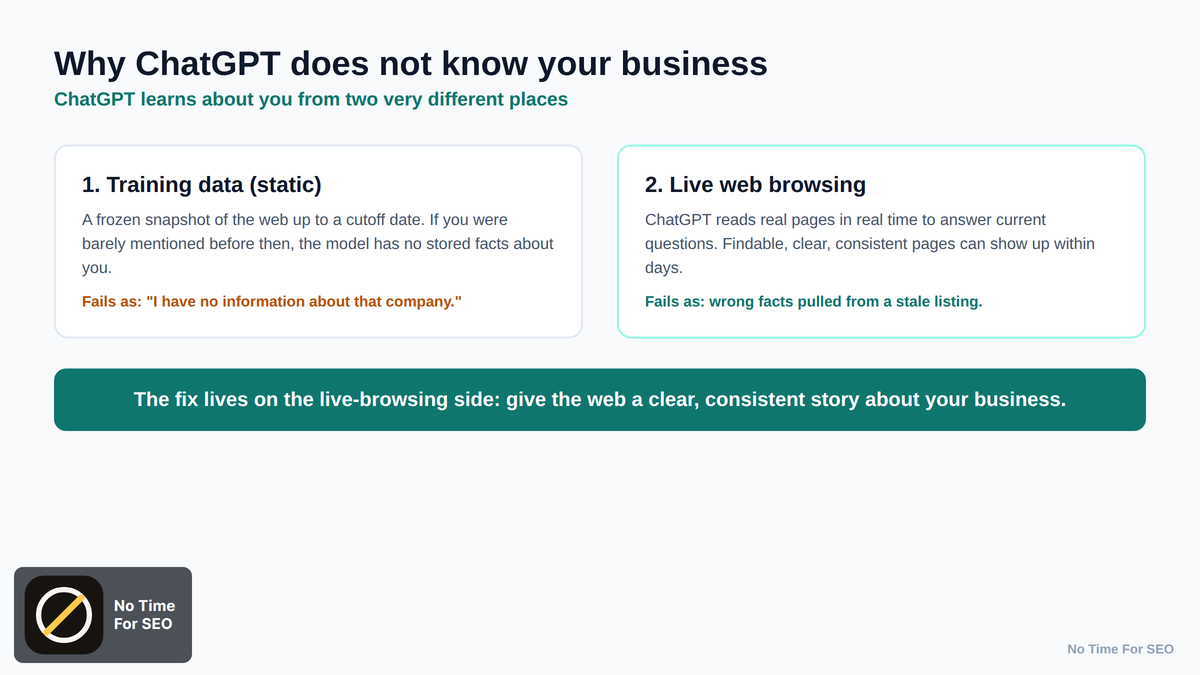
ChatGPT decides what it knows about your business from two separate sources, and they behave nothing alike. Confusing them is the single biggest reason owners misdiagnose why ChatGPT ignores their business.
- Training data: a frozen snapshot of the public web and licensed text, gathered up to a cutoff date. If you were barely mentioned online before that cutoff, the base model has no stored facts about you.
- Live web browsing: when ChatGPT judges that a question needs current information, it searches and reads pages in real time. This is where those 8,672 live fetches came from.
The two sources answer different questions and fail in different ways. The table below shows how each one behaves for a business owner.
| Dimension | Training data (static) | Live web browsing |
|---|---|---|
| When it applies | General or historical questions | Current, local, or “look this up” questions |
| Recency | Frozen at the knowledge cutoff | As current as the pages it fetches |
| Your new page from last week | Invisible until a future model is trained | Findable once search engines index it |
| Failure mode | “I have no information about that company” | Wrong facts pulled from a stale directory |
Takeaway: a brand-new page can reach ChatGPT through live browsing within days, but it will not enter the trained model until OpenAI ships a future version.
Does ChatGPT only know businesses in its training data?
No, ChatGPT does not only know businesses in its training data. When ChatGPT browses the live web to answer a question, it can surface a company it has no trained memory of, as long as that company has pages a search can find and read.
Why ChatGPT says it has “no information” about your company
ChatGPT says it has no information about your company when the public web has not told a clear, repeated story about who you are and what you do. ChatGPT weighs what other sites say about you more heavily than what your own site says about itself.
This is also why traditional SEO and AI search visibility are not the same game. Traditional SEO leans on backlinks and rankings. AI search visibility leans on semantic consensus: many independent sources describing your business in the same concrete terms.
A trading-education platform we run search for has 82 of its top 100 keywords on page one of Google, and 63% of its clicks come from non-branded searches (Google Search Console top-100 query sample, 28-day window ending July 12, 2026).
You can rank on Google and still be invisible to ChatGPT if the web has no consistent description of what you do. That trading platform’s strong, non-branded footprint is exactly the raw material AI systems need: both channels reward the same underlying clarity, even though they measure it differently.
Why does ChatGPT weigh third-party mentions more than my own website?
ChatGPT weighs third-party mentions more heavily because they are harder to fake than self-description. A news article, a directory entry, or a review profile represents a second party agreeing with your claims. When five independent sites describe your business the same way, that agreement is the semantic consensus a model can safely extract and repeat.
Is your business too new or too small for ChatGPT to know about it?
Yes, a brand-new or very small business can simply lack enough public material for ChatGPT to describe it, and that is the most common honest reason. ChatGPT cannot summarize a company the web has barely written about.
But “too new” is often a misdiagnosis. Plenty of small businesses are old enough and have a website, yet ChatGPT still draws a blank because their footprint is thin and inconsistent rather than absent. A three-year-old plumber with one unclaimed Google Business Profile and a vague homepage has an age problem in name only; the real barrier is that nothing on the web says clearly what the business does and where.
Is my business too new for ChatGPT to know about it?
Your business may be too new only if it has almost no public presence: no complete Google Business Profile, few directory listings, and no third-party mentions. Age itself is not the barrier. A one-month-old business with a complete profile, a clear website, and three or four consistent listings can appear in ChatGPT’s live-browsed answers before an established business that never cleaned up its scattered information.
Diagnose it: the exact prompts to run in ChatGPT this week
Before you fix anything, find out precisely how ChatGPT sees your business right now. Run these five prompts in ChatGPT with web browsing enabled, and write down the answers verbatim. This is the diagnostic step no other guide gives you.
- Test raw recognition: Type “What is [Business Name] in [City]?” If ChatGPT says it has no information, you have a visibility problem, not an accuracy problem.
- Test the description: Type “What services does [Business Name] offer and who are its customers?” Vague or wrong answers show the web is describing you badly.
- Test the category: Type “Recommend a [your category, e.g. family dentist] in [City].” If you are absent, you are missing from the consensus for your own category.
- Test the facts: Type “What are [Business Name]’s hours, address, and phone number?” Compare every field against reality to catch stale data.
- Test the source trail: Add “List the sources you used.” The URLs ChatGPT cites tell you exactly which pages shape its answer.
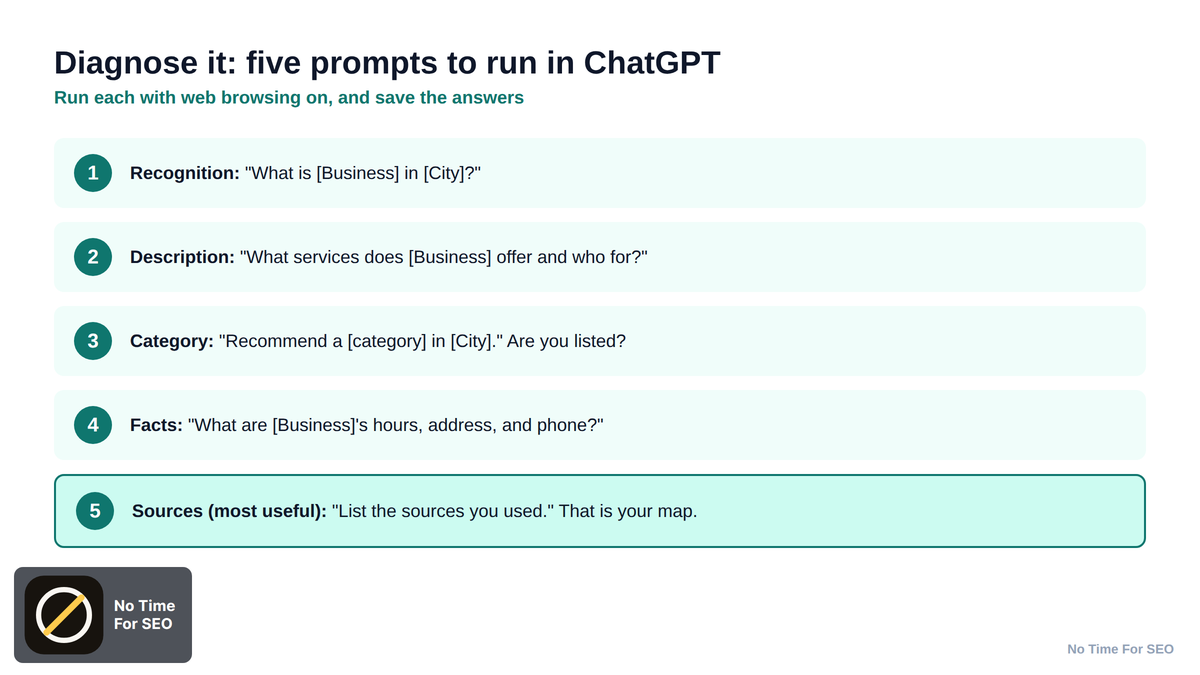
That fifth prompt is the most useful and the least known. The sources ChatGPT lists are your map. If it cites a stale Yelp page with your old address, you know precisely what to fix. If it cites nothing about you, the web is silent and your job is to give it something to read.
How to tell ChatGPT what your business does (rewrite vague copy)
You tell ChatGPT what your business does by publishing specific, concrete descriptions across your own site and every third-party profile, using the same words everywhere. Vague phrases like “innovative solutions” and “empowering businesses” carry zero extractable meaning, so ChatGPT cannot repeat them as facts. The fix is to name the exact service, the exact customer, and the exact place.
| Before (vague, unextractable) | After (specific, AI-legible) |
|---|---|
| “We deliver innovative solutions that empower modern businesses to thrive.” | “We manage SEO and AI search visibility for dentists, trading-education platforms, and local service businesses, with weekly server-log reporting.” |
| “A trusted partner for all your smile needs.” | “Riverside Family Dental is a five-location dental group in Austin offering cleanings, implants, Invisalign, and emergency care, open Saturdays.” |
Takeaway: every rewrite names the service, the customer, and the place, so ChatGPT can lift a whole sentence and attribute it to you.
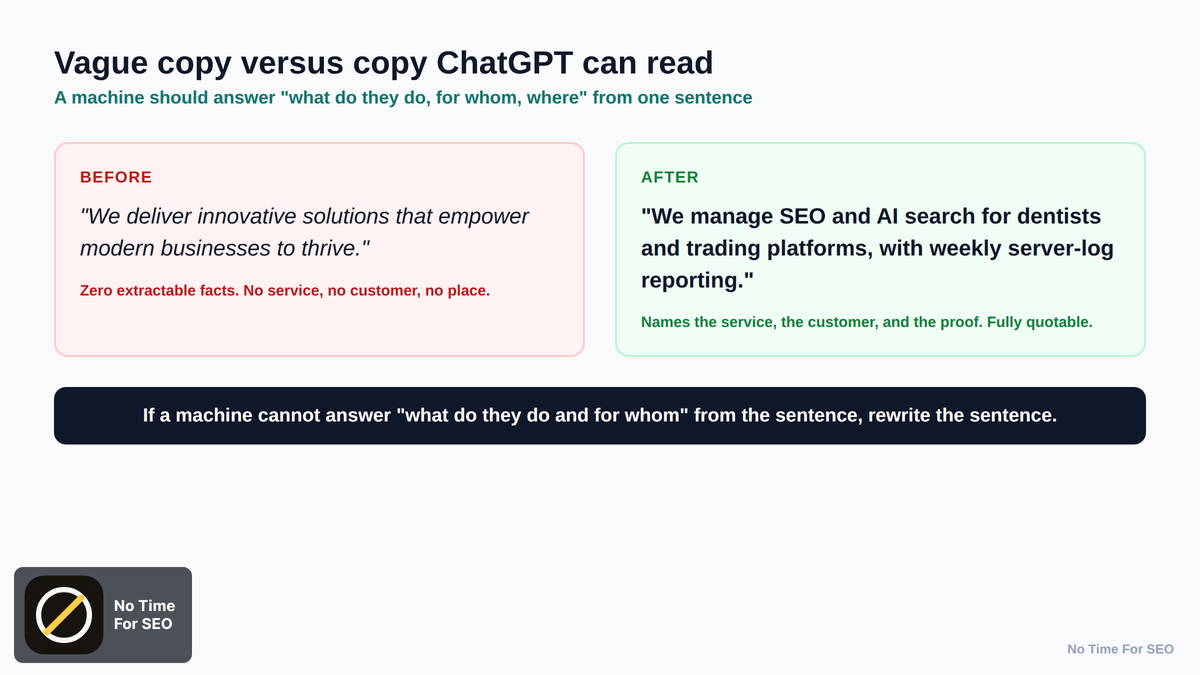
Notice what the “after” versions do. They contain nouns a model can index: dentists, implants, Austin, Saturdays. A machine reading your page should answer “what do they do and who for” from a single sentence. If it cannot, rewrite the sentence.
How do I tell ChatGPT what my business does?
Tell ChatGPT what your business does by writing one plain sentence that names your service, your customer, and your location, then repeating that same description on your homepage, your Google Business Profile, and your directory listings. ChatGPT reads these public sources and repeats the description it sees most consistently, so identical wording across sites is what makes the message stick.
The signals that actually move ChatGPT, ranked by leverage
The signals below are the levers that change what ChatGPT can say about you. Nobody outside OpenAI knows the exact weighting, so treat this as observed behavior and our own measurements, not insider rules.
| Signal | What it tells ChatGPT | Your action |
|---|---|---|
| Google Business Profile | Baseline identity: name, address, phone, category, hours | Claim it, complete every field, pick the exact category |
| Third-party mentions | Independent confirmation of who you are | Earn directory, news, and review-site listings |
| Structured data / schema markup | Machine-readable labels for your business type and offerings | Add LocalBusiness or Organization schema |
| Dedicated page per question | A thorough answer beats a passing mention | Build one page that fully answers each key question |
| Entity consistency | Same name and details everywhere means one real business | Match name, address, and description across all sites |
Takeaway: a complete Google Business Profile plus consistent third-party listings is the baseline; schema and dedicated pages are the multipliers.
- Structured data (schema markup): invisible code that labels your content so machines can read it. It explicitly tells AI systems “this is a dental practice, here are its services, here are its hours.”
- A dedicated page per question: a page that thoroughly answers one question beats a passing mention buried in a paragraph. If people ask ChatGPT “does [business] do emergency visits,” you want a page whose whole job is answering that.
One researched article we wrote for a five-location dental group earned 52,171 Google impressions in one month while ranking on page one (Google Search Console, July 2026, client kept anonymous).
That is one page, answering real questions in plain language. Does the thorough-page approach pay off? The impressions above say it can, though nobody can promise a specific number for your page.
Multi-location and franchise businesses: the consistency trap
Multi-location and franchise businesses fail with ChatGPT most often because their information drifts apart across locations, not because any single listing is wrong. Every new location, listing, or manager is a chance for the name, category, or hours to diverge.
The fix is a single source of truth. Keep one master record of exact name, address, phone, category, and description for every location, then push that identical text everywhere. When ChatGPT reads ten listings that agree, it becomes confident; when it reads ten that disagree, it hedges or picks the wrong one.
After our takeover, 53% of that five-location dental group’s Google clicks came from non-branded searches, meaning people who did not already know the practice name (top-100 query sample, Google Search Console, July 2026).
Consistent, well-described locations get discovered by strangers, which is exactly the audience AI recommendations reach.
Why ChatGPT gives wrong information, and how to correct it
ChatGPT gives wrong information about your business when it reads outdated or conflicting sources and stitches them into a confident-sounding answer. It is not lying; it is repeating the most consistent story the web tells, and if that story is stale, the answer is stale.
Why does ChatGPT give wrong information about my business?
ChatGPT gives wrong information about your business because it pulls from whatever public sources it can find, and old directory entries, closed-location listings, and outdated review profiles often outrank your current site in its view. When your correct information lives in fewer or weaker places than the wrong information, the wrong version wins by weight of repetition.
How do I correct false information ChatGPT says about my business?
You correct false information by fixing the sources ChatGPT reads, not by arguing with ChatGPT in the chat window. Corrections you type into a conversation do not persist or change the model. Work through these steps in order.
- Find the sources: Ask ChatGPT to list the sources behind the wrong answer, then open each one.
- Fix the origin: Update the incorrect field on your Google Business Profile, your website, and any directory showing stale data.
- Flush the duplicates: Correct or remove old listings, closed-location pages, and abandoned profiles that repeat the error.
- Publish the truth clearly: Put the correct fact in plain text on a page you control, so the right version has the strongest, most consistent source.
- Re-test after indexing: Wait for search engines to re-crawl, then run your diagnostic prompts again to confirm the change.
How long until ChatGPT’s answers actually change?
ChatGPT’s answers change on two very different clocks, and knowing which one applies keeps you from panicking too early. No other guide on this query spells out this lag, so here is the honest picture from what we observe.
- Live browsing: the gate is search-engine indexing. Once a new or corrected page is indexed and ChatGPT chooses to browse for that question, the fresh information can appear in days to a few weeks. This is the fast path.
- The trained model: the wait is measured in model releases, not days. A fact that only lives on your brand-new page will not enter ChatGPT’s static memory until OpenAI trains and ships a future version.
Nobody outside OpenAI knows that training schedule, so we never promise a date. Anyone who promises you a fixed position or a locked-in timeline is overselling.
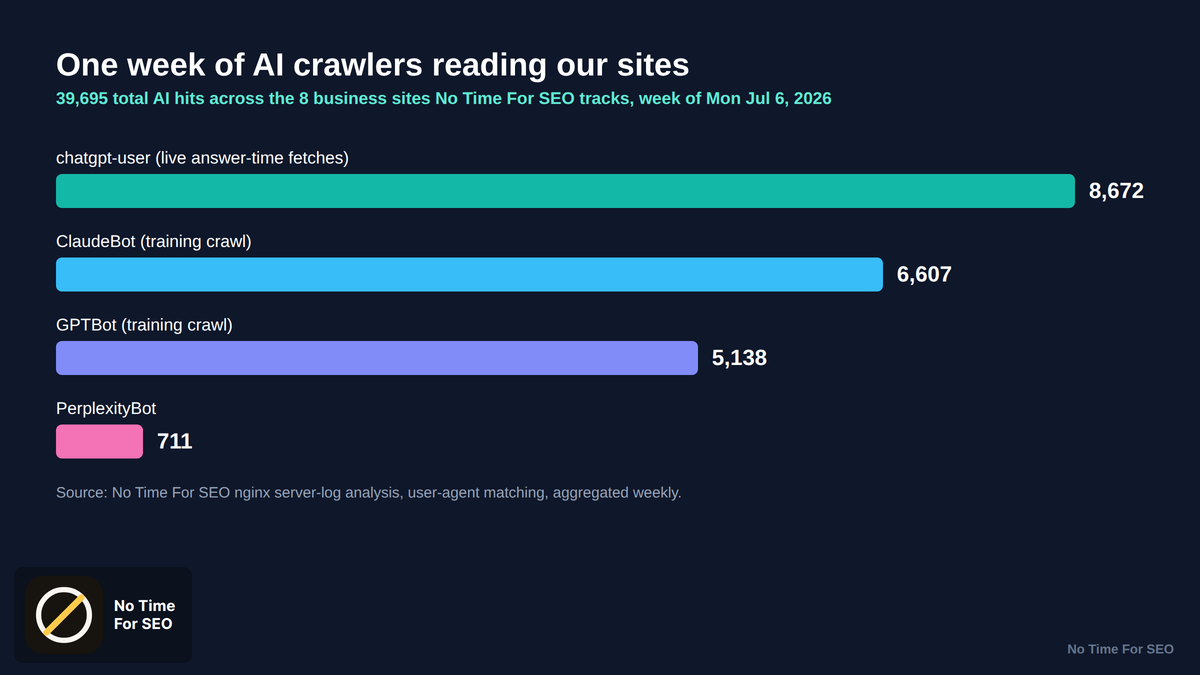
Here is why the fast path is worth trusting: the crawlers are genuinely active. In the week of Monday, July 6, 2026, No Time For SEO recorded 39,695 AI crawler and agent hits across the 8 sites it tracks in server logs.
Training crawlers hit those sites 11,745 times that week (GPTBot 5,138, ClaudeBot 6,607) against 711 PerplexityBot hits. The machines are reading constantly.
Give them something clear to read and the live path moves quickly. That speed is why the one-week plan below is worth starting now rather than later.
Your one-week action plan to get ChatGPT to know your business
Here is exactly what to do this week, with time estimates, so ChatGPT starts describing your business correctly. Do the diagnosis first, then work the fixes in order of leverage.
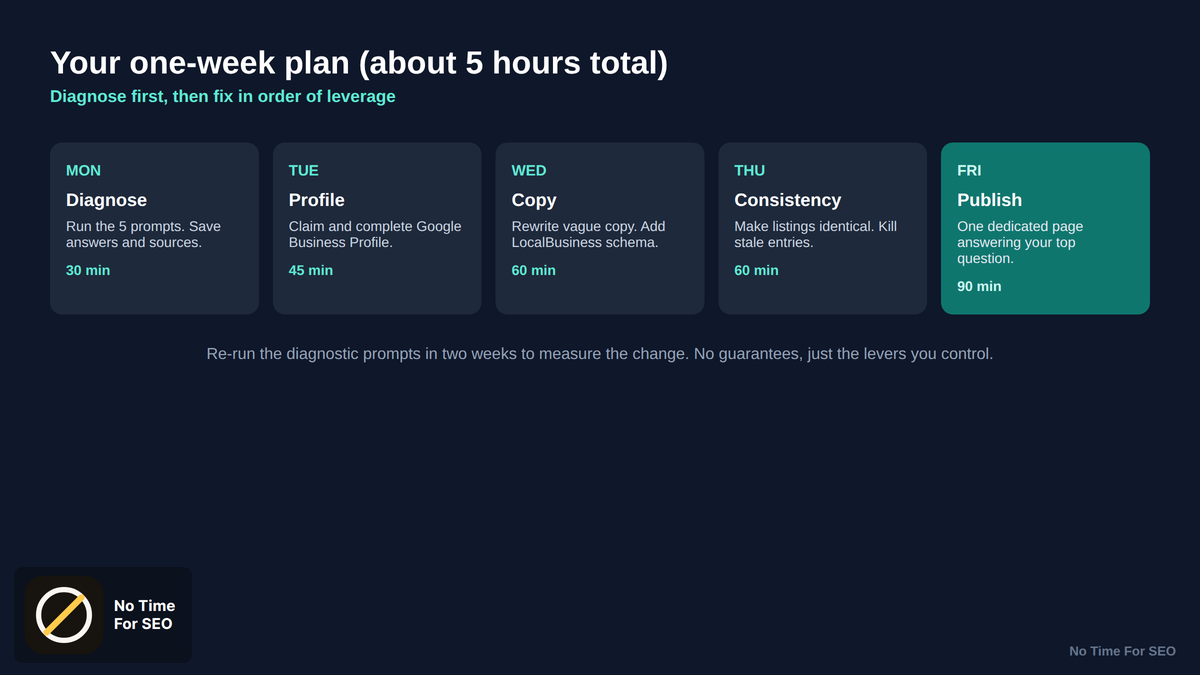
- Monday, diagnose (30 minutes): Run the five diagnostic prompts in ChatGPT, Perplexity, and Google AI Overviews. Save every answer and every source URL.
- Tuesday, fix your profile (45 minutes): Claim and complete your Google Business Profile. Fill name, address, phone, category, service area, and hours. Match your website exactly.
- Wednesday, rewrite your copy (60 minutes): Replace vague homepage and about-page language with specific sentences naming your service, customer, and location. Add LocalBusiness schema.
- Thursday, fix consistency (60 minutes): Audit your top directory and review listings. Make the business name and description identical everywhere. Correct or remove stale and closed-location entries.
- Friday, publish one dedicated page (90 minutes): Build one page that thoroughly answers your single most-asked customer question, in the exact words people use, and link it from your homepage.
That is roughly five hours of focused work. It will not put you in ChatGPT’s trained memory, since only a future model release does that, and it does not promise you a citation.
What it does is give the live web a clear, consistent, machine-readable story about your business, which is the one thing entirely inside your control. Re-run your diagnostic prompts in two weeks to measure the change.
Frequently asked questions
Why does ChatGPT say it has no information about my company?
ChatGPT says it has no information about your company when the public web has not told a clear, repeated story about who you are and what you do. ChatGPT relies on third-party mentions and consistent listings, not your website alone. If those are thin, absent, or contradictory, ChatGPT has nothing confident to extract and repeat, so it declines to answer.
Does ChatGPT only know businesses in its training data?
No. ChatGPT can surface businesses absent from its training data by browsing the live web when it decides a question needs current information. Training data sets its default knowledge; live browsing can override it, as long as your business has findable, readable, consistent pages for the search to reach.
Is my business too new for ChatGPT to know about it?
Your business is too new only if it has almost no public presence. Age itself is not the barrier. A one-month-old business with a complete Google Business Profile, a clear website, and a few consistent directory listings can appear in live-browsed answers before an older business whose information is scattered and vague.
How do I tell ChatGPT what my business does?
Write one plain sentence naming your service, your customer, and your location, then repeat that identical description on your homepage, your Google Business Profile, and your directory listings. ChatGPT reads these public sources and repeats the most consistent description, so matching wording across sites is what makes the message land.
How do I correct false information ChatGPT says about my business?
Correct false information by fixing the sources ChatGPT reads, not by arguing in the chat. Ask ChatGPT to list its sources, update the incorrect fields on your profile, website, and directories, remove stale or closed-location listings, then re-test once search engines re-crawl. Corrections typed into a conversation do not persist.
Will fixing my website make ChatGPT recommend my business?
Not on its own, and nobody can promise a ChatGPT recommendation, because nobody outside OpenAI knows the exact ranking rules. Anyone promising a fixed, locked-in position is overselling. A clear, consistent, well-described public footprint is the strongest lever you control, and it measurably raises your odds, but it is odds, not a promise.
Want your business named in answers like these?
Send us your website. In two business days you get a free, human written report on where you show up on Google and in AI answers, and what we would fix first.
Get your free audit →