Category: AI Search

  • How to Check If ChatGPT Recommends Your Business

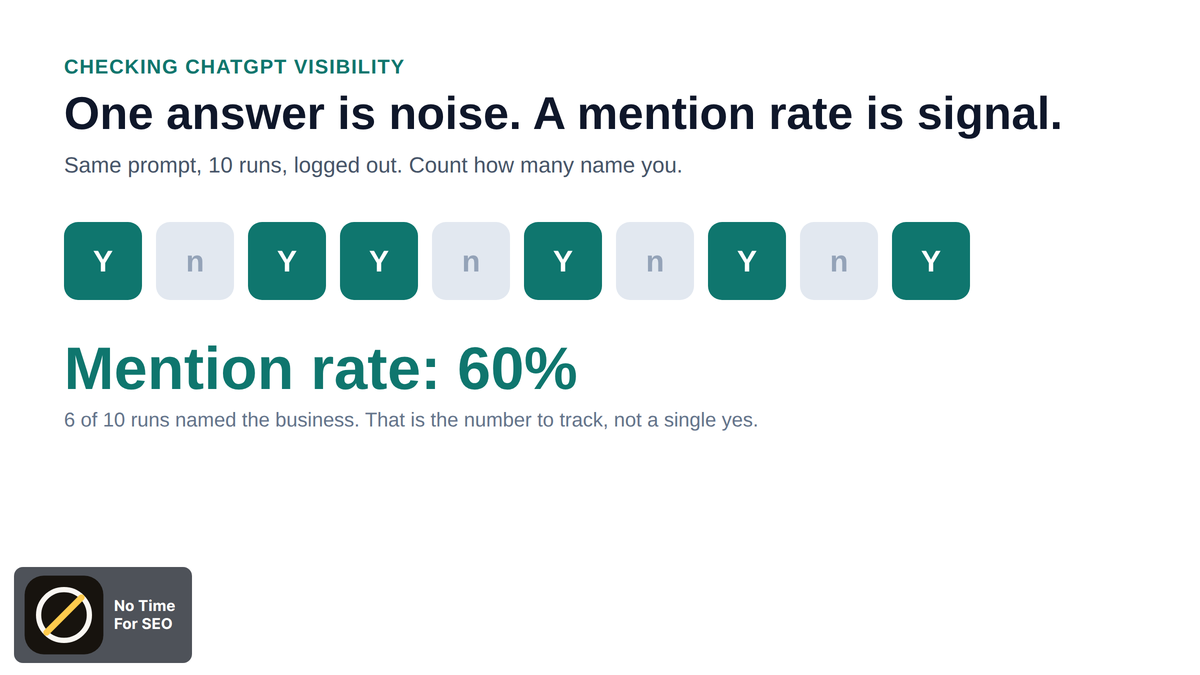
    To check whether ChatGPT recommends your business, ask it the exact question a real buyer would type (like “best [service] in [city]”), run that same prompt 8 to 10 times in a fresh logged-out session, and count how many runs name you. That count divided by total runs is your mention rate. One lucky “yes” from a single run is noise, not a signal.
    how to check if chatgpt recommends my business: mention rate hero

    Most guides on this keyword are written by tools that want you to buy a tracker. This one is not. Below is the complete manual method you can run this afternoon for free, plus what our own server logs show about how often ChatGPT actually reads business pages.

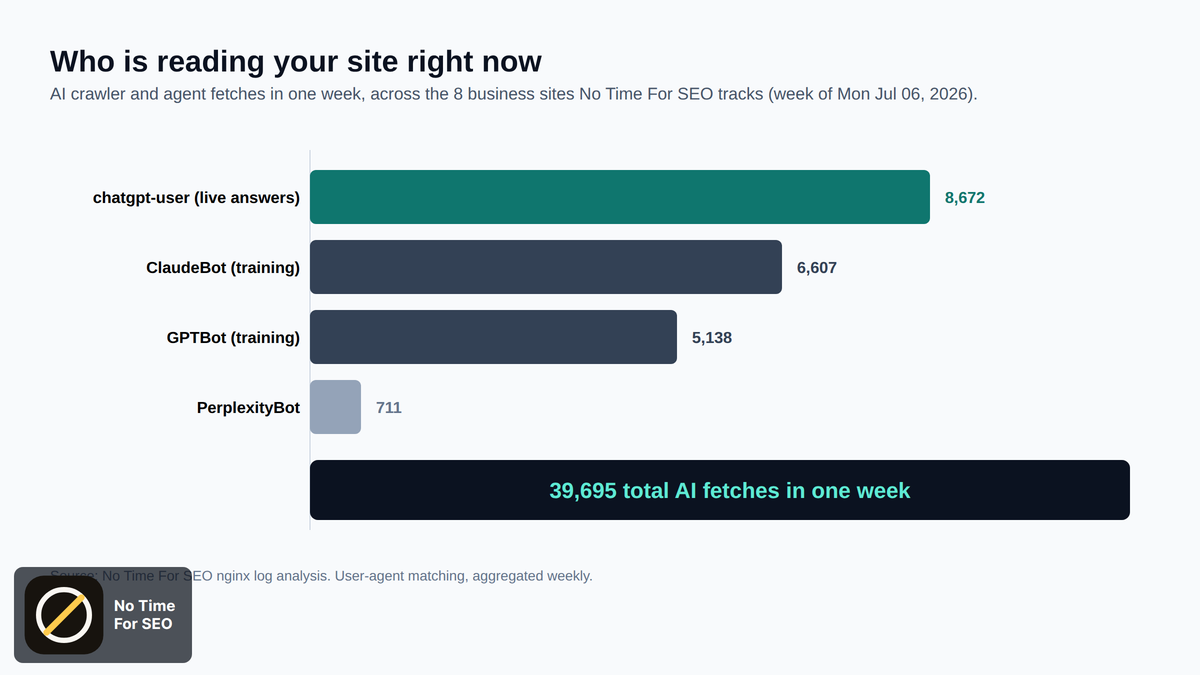
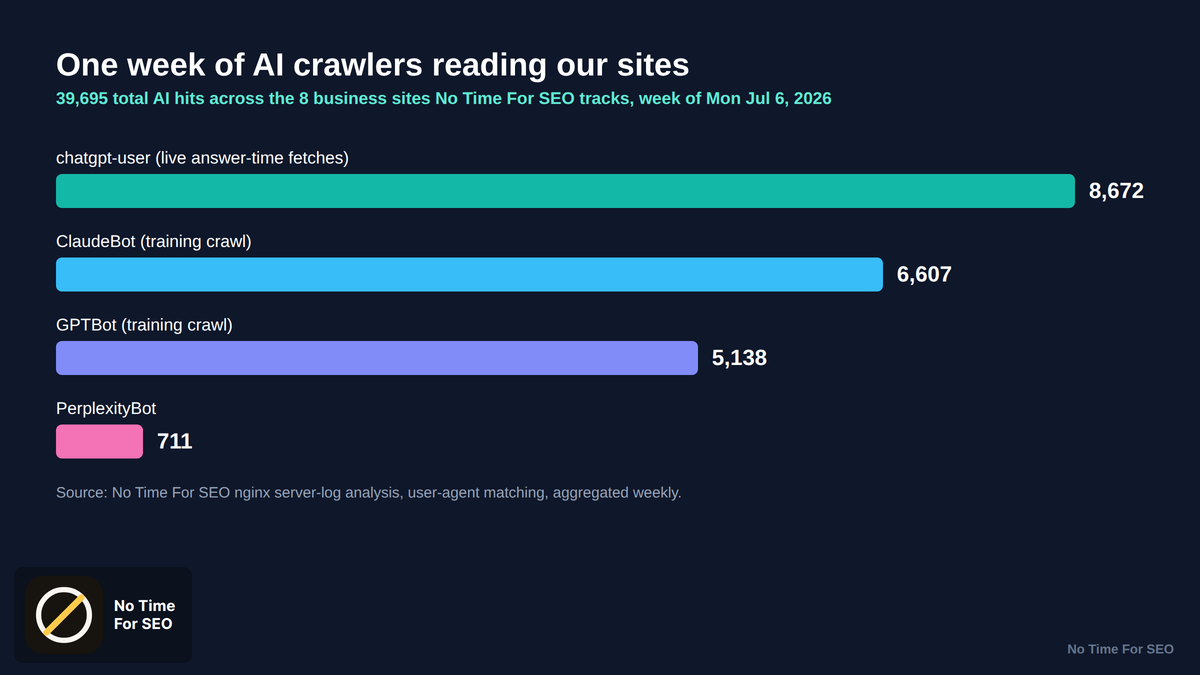
    Here is the number that reframes the exercise: across the 8 business sites No Time For SEO tracks in raw server logs, AI crawlers and agents made 39,695 hits in one week (the week of Monday July 6, 2026). Of those, 8,672 were live answer-time fetches from chatgpt-user, the agent ChatGPT sends to read a page when a real person asks a question.


    How to check if ChatGPT recommends your business (the 10-minute manual method)

    The manual check for ChatGPT visibility takes about 10 minutes and needs nothing but a browser. The goal is a mention rate, not a yes or no. Follow these steps exactly.

    1. Open a logged-out session. Use a private or incognito window, or log out of ChatGPT, so past chats and memory cannot bias the answer toward your own brand.
    2. Pick one buyer-intent prompt. Write the question a stranger would ask, phrased as a need, not your business name. Example: “best emergency dentist in Austin.”
    3. Run the exact same prompt 8 to 10 times. Start a new chat for each run. Do not paste follow-ups into one thread, because context inside a thread changes later answers.
    4. Log each run in a simple tally. For every run, mark three things: were you named, were you recommended and linked, and which competitor got named instead.
    5. Check the sources ChatGPT cites. When ChatGPT shows citations, note whether your domain is one of the source URLs it pulled from.
    6. Calculate your mention rate. Divide the runs that named you by total runs. Six out of ten is a 60% mention rate. Zero out of ten is a real answer too.
    Tip: Being named is not the same as being recommended. ChatGPT might list your business in a paragraph while linking a competitor as the “top pick.” Log those separately, because a link is worth more than a mention.

    That is the entire core method. Everything below makes your result more accurate, harder to fool yourself with, and repeatable month over month.


    Why does ChatGPT give a different answer every time you ask?

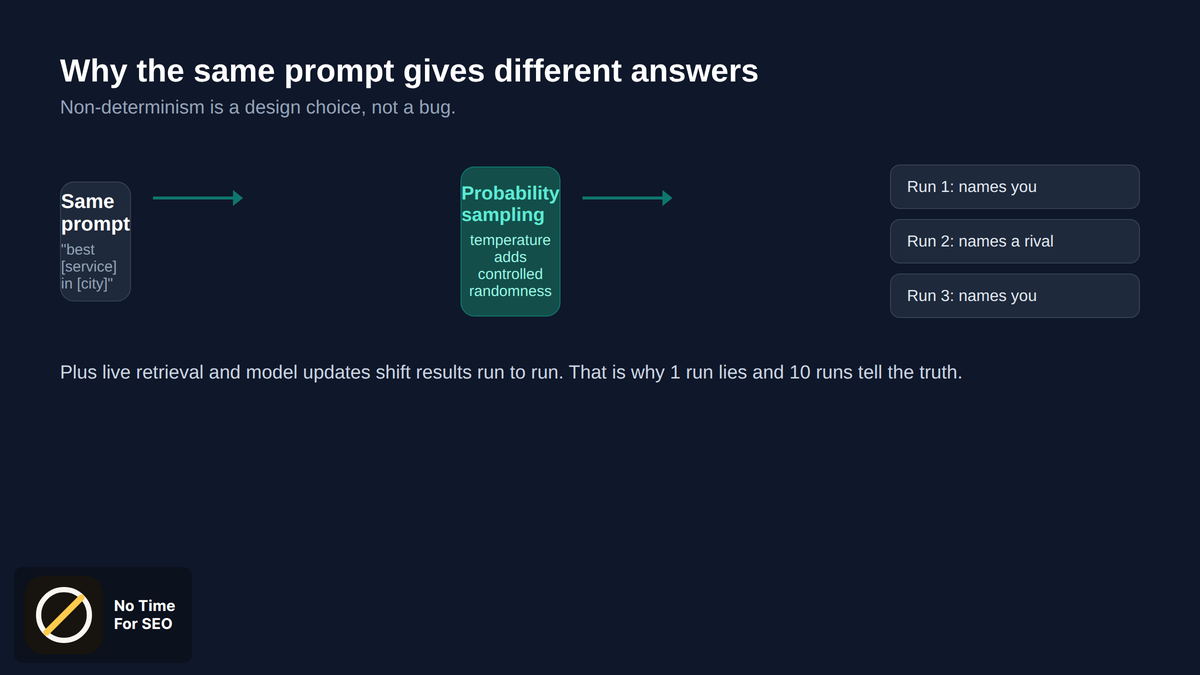
    ChatGPT gives a different answer to the same prompt because it samples words probabilistically, not because it is broken. A setting called temperature adds controlled randomness, so a single check lies in both directions: one run can show a fluke, another can hide a business ChatGPT names 40% of the time.
    how to check if chatgpt recommends my business: nondeterminism flow

    Two other forces move the answer between runs beyond sampling, and both are normal behavior rather than bugs:

    1. Live retrieval. When ChatGPT fetches fresh pages through its browsing agent, the sources it lands on can differ run to run.
    2. Model updates. OpenAI ships changes, so a mention rate from March is not a mention rate for July.
    Watch out: Nobody outside OpenAI knows the exact ranking rules ChatGPT uses to choose which business to name. We can measure observed behavior, like how often you appear across many runs. We cannot read the internal weights, and anyone who claims to is guessing.

    What prompts should you use to test if ChatGPT recommends you?

    The prompts that test ChatGPT recommendation should be the real questions your buyers ask, spread across categories, comparisons, and problem-solution phrasing. Never test your own brand name. Build a small set of 10 to 20 prompts, because ChatGPT can surface you for “affordable” queries and miss you for “best” queries, and one prompt hides that split.

    Prompt type Example wording What it tests
    Category “best [service] in [city]” Whether you surface for core discovery intent
    Comparison “[competitor] alternatives for [need]” Whether you appear next to named rivals
    Problem-solution “how do I fix [problem] in [city]” Whether you win the “who can help” moment
    Recommendation “who should I hire for [job] near me” Whether ChatGPT actively recommends, not just lists
    Qualifier “most affordable [service] in [city]” Whether specific buyer priorities surface you
    A five-category prompt template: build 2 to 4 real prompts per row for a 10 to 20 prompt buyer-intent set.

    Test across engines too, because ChatGPT, Perplexity, Google AI Overviews, Gemini, and Claude are different systems that pull sources differently. A business Perplexity loves can be invisible in ChatGPT. Run your set in each one and score them separately. Never lump them together as “the AIs.”


    How many times should you run each prompt to check your visibility?

    Run each prompt at least 8 to 10 times to get a mention rate you can trust, and 20 times when the decision matters or the result sits near a boundary. The reason is sample size: with a random signal, a handful of runs has a wide margin of error, and three runs that split two-to-one could easily be a coin that is actually 50/50.

    1. Run 10 times for a routine monthly check. Good enough to catch big swings and track direction over time.
    2. Run 20 times when the answer is borderline. If your first 10 land around 4, 5, or 6 out of 10, add another 10 before you conclude anything.
    3. Treat 0 out of 10 and 10 out of 10 as real. Extremes stabilize fast. A clean zero or a clean ten rarely flips with more runs.
    Tip: Keep the run count identical every month. A mention rate is only comparable over time if the denominator does not move. Ten runs in July versus three runs in August tells you nothing.

    Should you check in incognito or logged in for accurate results?

    Check your ChatGPT visibility in a logged-out or incognito session, never in your everyday logged-in account. A logged-in ChatGPT account with memory and chat history can quietly bias answers toward your own brand, because it remembers you run this business. That produces a false positive: ChatGPT names you for you, not for a stranger.
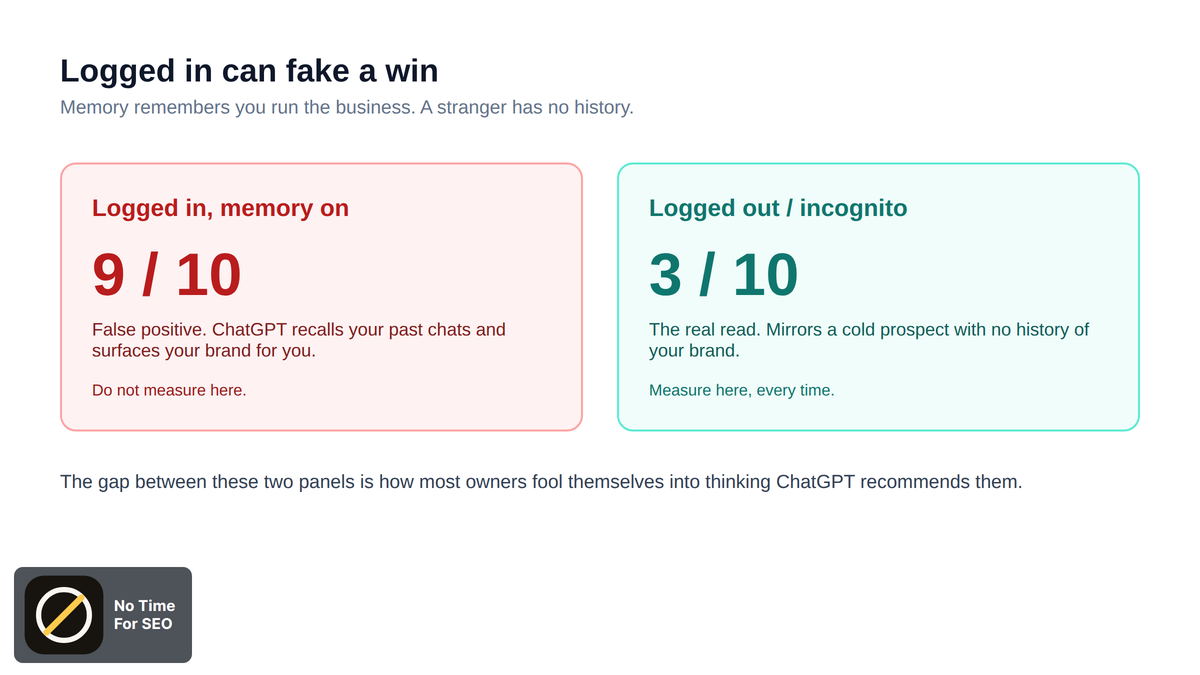
    how to check if chatgpt recommends my business: logged in bias

    This is the single most common way owners fool themselves. You have typed your business name into ChatGPT dozens of times, memory picks that up, and then a cold prospect in a fresh session may never see the name you keep seeing.

    1. Turn off memory or use incognito. In ChatGPT, open a temporary chat or disable memory in settings before testing.
    2. Log out entirely for the strictest test. A logged-out session most closely mirrors a stranger with no history.
    3. Change nothing else between runs. Same account state, same region, same prompt wording, every time.

    How do you measure your visibility score in ChatGPT?

    Measure your ChatGPT visibility as a mention rate and a share of voice across a logged run set, not as a single yes-or-no check. Mention rate is how many runs named you out of the total. Share of voice is how often you were named compared with every competitor named across the same runs. Log every run in one small worksheet so the score is repeatable next month.

    Prompt Runs Times named Times recommended + linked Mention rate Top competitor named
    best [service] in [city] 10 6 3 60% Competitor A
    [competitor] alternatives 10 2 1 20% Competitor B
    who should I hire for [job] 10 0 0 0% Competitor A
    A repeatable ChatGPT visibility worksheet: one row per prompt, mention rate as named runs divided by total runs, logged monthly.

    Read the worksheet in three numbers. Your overall mention rate is total named runs divided by total runs. Your recommendation rate is the stricter figure: times recommended and linked, divided by total runs. Your share of voice is your names divided by all business names logged. Track all three monthly.
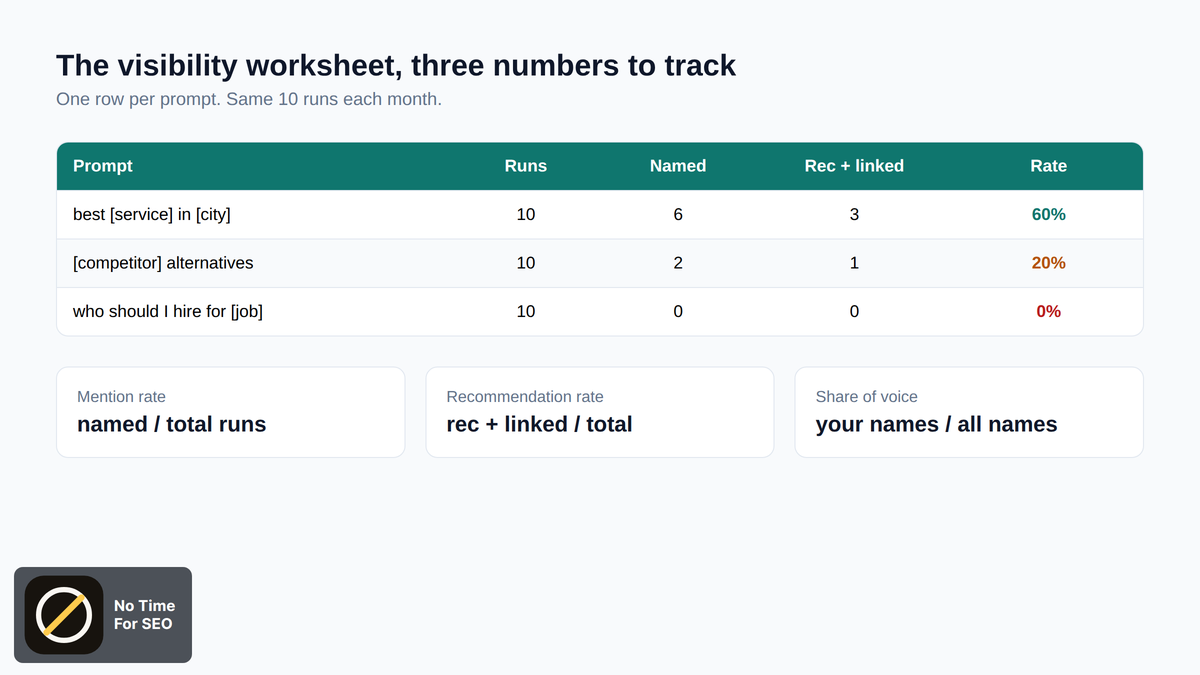
    how to check if chatgpt recommends my business: scoring worksheet

    What our AI crawler logs show about how ChatGPT reads business pages

    Across the 8 business sites No Time For SEO tracks in raw server logs, AI crawlers and agents made 39,695 hits in the week of Monday July 6, 2026. That is the real volume of machine reading happening on ordinary business sites right now, measured in nginx logs, not estimated.

    Crawler or agent Hits, week of Mon Jul 6, 2026 What it means
    chatgpt-user 8,672 Live answer-time fetches: ChatGPT reading a page to answer a real person
    ClaudeBot 6,607 Anthropic training and indexing crawl
    GPTBot 5,138 OpenAI training crawl
    PerplexityBot 711 Perplexity crawl
    All AI crawlers + agents 39,695 Total AI machine reads across 8 tracked sites in one week
    AI crawler and agent hits across the 8 sites No Time For SEO tracks, week of Monday July 6, 2026: chatgpt-user live reads outnumbered PerplexityBot more than 12 to 1.

    The split matters for your mention rate. In that same week, chatgpt-user, the live answer-time agent, fetched pages 8,672 times, far more than PerplexityBot’s 711 and more than training crawlers like GPTBot at 5,138. If ChatGPT is not naming you, it is often not because it never read the space. It is because your page was not the one worth citing.

    Where these numbers come from: We match known AI user-agents (GPTBot, ClaudeBot, PerplexityBot, OAI-SearchBot, chatgpt-user, meta-ai, amazonbot, bingbot) in raw nginx access logs across the 8 business sites we manage, then aggregate weekly. chatgpt-user hits are live answer-time reads and are counted separately from GPTBot training crawls. Client names stay anonymous; full methodology is available on request.

    Can traditional rank trackers show your ChatGPT visibility?

    Traditional rank trackers cannot show your ChatGPT visibility, because they measure a fixed, ranked list of blue links and ChatGPT produces a personalized, non-deterministic answer with no stable position. A tool built to report “you rank number 4 for [keyword]” has no number 4 to report inside a ChatGPT reply that reshuffles every run.

    Dimension Traditional rank tracker Manual ChatGPT check
    What it measures Fixed position for a keyword Mention rate across many runs
    Determinism Stable day to day Varies every run by design
    Personalization Mostly neutral Biased by login, memory, region
    Output Ranked link list Synthesized answer with some citations
    Traditional rank trackers report a fixed keyword position; a ChatGPT check reports a mention rate that varies by run, login state, and region.

    This does not mean traditional SEO stops mattering, because it still builds the pages and trust signals ChatGPT reads. One researched article No Time For SEO wrote for a 5-location dental group earned 52,171 Google impressions in one month while ranking on page one, measured in July 2026. That page is exactly the kind of asset a live ChatGPT read can land on and cite.


    How to read a negative result and turn it into next steps

    A ChatGPT visibility score of 0 out of 10 is a specific diagnosis, not a generic “improve your content” verdict. It means that when ChatGPT answered your buyer’s question, it chose other sources. Your next move depends on which of three failure points you hit, so check them in order.

    1. Check who got named instead of you and why. Read the competitors ChatGPT recommends and note what they have that you do not: a dedicated page for the exact query, reviews, third-party mentions.
    2. Check the source URLs ChatGPT cited. If it linked directory sites and review roundups, the fix is getting listed and mentioned there, not just editing your homepage.
    3. Check whether a page even answers the query. If no page on your site directly answers “best [service] in [city],” there is nothing for ChatGPT to cite. Build that page first.

    Trust signals feed this. ChatGPT and Google AI Overviews lean on a complete Google Business Profile and independent third-party mentions when deciding who to surface for local intent. After our takeover, 53% of that dental group’s Google clicks came from non-branded searches, from people who did not know the practice name, measured across the top-100 query sample in July 2026.

    Tip: For a deeper walk through publishing the kind of page that earns citations, see our foundational guide. Managing this end to end is what No Time For SEO does for clients, and you can run every step in this article yourself without hiring anyone.

    Manual spot-checking versus automated AI-visibility tools

    Manual spot-checking in the ChatGPT app is the right first move; automated GEO tools are for scale, not accuracy. GEO means generative engine optimization, the practice of tracking and improving how AI answer engines represent you. A tool runs hundreds of prompts across engines on a schedule so you do not click 200 times a month by hand.

    1. Manual checking is free, transparent, and enough to get a real answer, but it does not scale past a handful of prompts.
    2. Automated trackers scale and chart trends, but you pay, and you still cannot see ChatGPT’s internal ranking rules any more than a manual check can.

    Our standing house line applies to both: anyone promising you a locked-in spot in ChatGPT answers is overselling. What you can do is measure honestly, publish the page that deserves the citation, and track the mention rate over time. As proof, a trading-education platform No Time For SEO runs search for has 82 of its top 100 keywords on page one of Google, with 63% of clicks non-branded, measured in July 2026.


    Frequently asked questions

    How do I know if ChatGPT recommends my business right now?

    Open a logged-out ChatGPT session, ask the exact buyer question (“best [service] in [city]”), run it 10 times in fresh chats, and count how many name you. Six of ten is a 60% mention rate. One check is unreliable because ChatGPT answers vary every run by design.

    Why does ChatGPT recommend a competitor and not me?

    ChatGPT recommends the source it judged most citable for that query. Usually the competitor has a page answering the exact question, plus trust signals like a complete Google Business Profile, reviews, and third-party mentions. Read the citations ChatGPT shows to see which sources it pulled from.

    Is checking ChatGPT visibility the same as checking my Google rank?

    No. Google rank is a fixed position a rank tracker can report. ChatGPT visibility is a mention rate across many non-deterministic runs, biased by login and region. Traditional rank trackers cannot measure it. Strong Google rankings help your odds but do not guarantee ChatGPT names you.

    How often should I re-check my ChatGPT visibility?

    Run a monthly baseline of 10 runs per prompt, and re-check within a week of any major site change or new page launch. Keep the run count and prompt wording identical each time, or the mention rate is not comparable month to month.

    Does asking ChatGPT about my own brand name count as a real test?

    No. Asking “is [your business] good” only proves ChatGPT can read the name you typed. It says nothing about discovery. Test the need a stranger would type, like “best [service] in [city],” never your brand name, and always in a logged-out session.


    Your do-this-now checklist for this week

    1. Write 10 buyer-intent prompts across category, comparison, problem-solution, recommendation, and qualifier wording. No brand names.
    2. Open a logged-out or incognito ChatGPT session so memory cannot inflate your score.
    3. Run each prompt 10 times in fresh chats and log named, recommended-and-linked, and top competitor for every run.
    4. Calculate your mention rate and share of voice using the worksheet table above.
    5. Read the citations to see whether your domain is a source ChatGPT pulls from.
    6. Repeat the exact set in Perplexity, Gemini, Claude, and Google AI Overviews and score each engine separately.
    7. For any 0 out of 10 prompt, build or fix the page that answers that exact query, then re-check next month.
  • How AI Chatbots Choose Which Business to Recommend

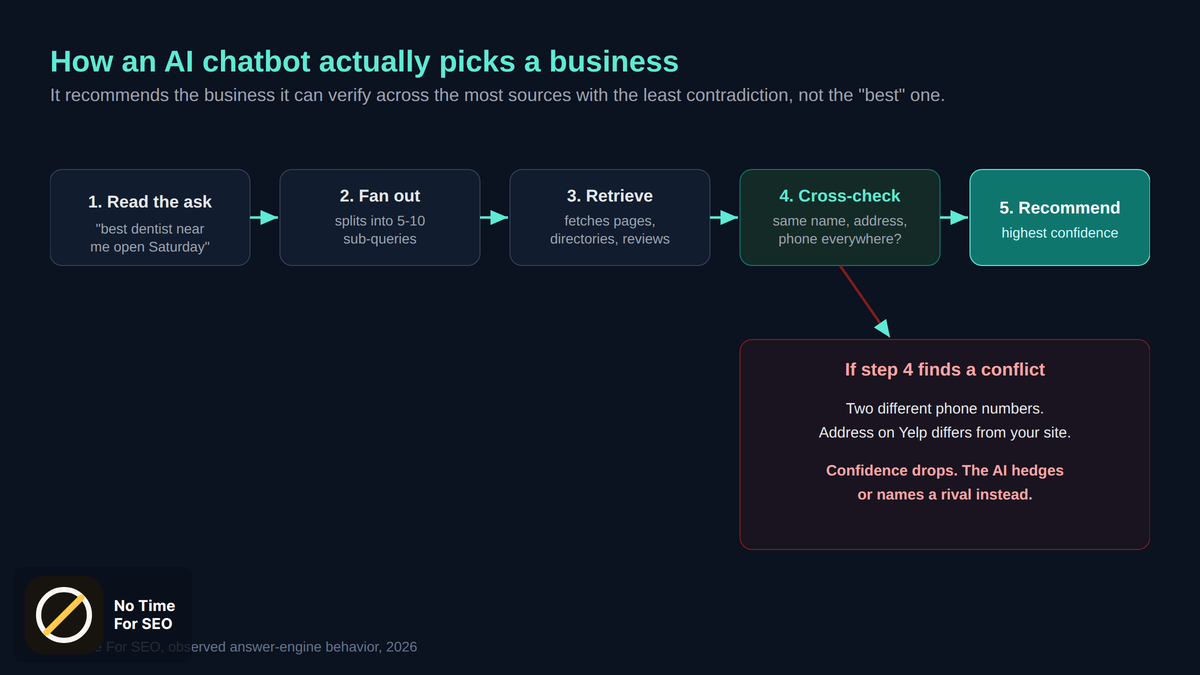
    AI chatbots recommend the business whose facts they can verify across the most independent sources with the least contradiction. They do not pick the “best” company in any human sense. They pick the one they are most confident describing correctly.

    how do ai chatbots choose which businesses to recommend: how ai picks

    Across the 8 business sites No Time For SEO tracks in raw server logs, AI crawlers and agents made 39,695 fetches in a single week (week of Monday July 06, 2026). That traffic is the machine deciding whom it can trust.

    • What this guide answers: which signals actually move an AI recommendation, and which ones do nothing.
    • Where the numbers come from: our own nginx server logs and Google Search Console, plus one named external study.
    • What you do this week: a concrete checklist a busy owner can finish in an afternoon.

    One honest boundary before the mechanics: nobody outside OpenAI, Anthropic, or Google knows the exact ranking rules. What follows is observed behavior from our own logs and citation checks, not an insider claim.

    Watch out: Treat any “AI ranking formula” you read elsewhere with skepticism. If a page states the precise weights ChatGPT or Perplexity uses, it is guessing and presenting the guess as fact.

    What ranking factors do AI assistants use to pick a business?

    AI assistants pick a business using verifiable trust signals, not marketing copy. The strongest signals are consistent name, address, and phone details across platforms, a spread of recent reviews, structured data the machine can read, presence in authoritative directories, and specific factual content on your own website.

    Signal the AI reads What it is checking Your move this week
    NAP consistency Same name, address, phone on every platform Audit Google, Bing, Apple, Yelp for mismatches
    Review profile Volume, sentiment, recency, multi-platform spread Ask 5 recent customers for a detailed review
    Structured data LocalBusiness and FAQPage schema it can parse Add LocalBusiness schema to your homepage
    Directory presence Listing in trusted, industry-relevant directories Claim your Bing Places and Apple Maps listings
    Website specificity Plain, factual, service-specific pages Write one page per service with real detail
    Third-party authority Citations and links from trusted sources Get listed on one respected industry site
    The six signals AI assistants weigh when choosing which business to recommend, with one concrete action for each.

    No single signal wins. The AI stacks these into a confidence score and recommends the highest-confidence match for the query. Standard Google ranking explains only a small share of AI citations: being in Google’s top ten gives roughly a one-in-four chance of showing up in an AI answer, per Search Engine Land’s 2025 reporting.

    What the machine ignores

    Notice what is missing from that table: ad spend, keyword density, and a slick homepage. Those move human clicks. They do not move a machine that is trying to confirm you are a real, consistent entity across the open web.


    Does inconsistent name, address, and phone hurt my AI recommendations?

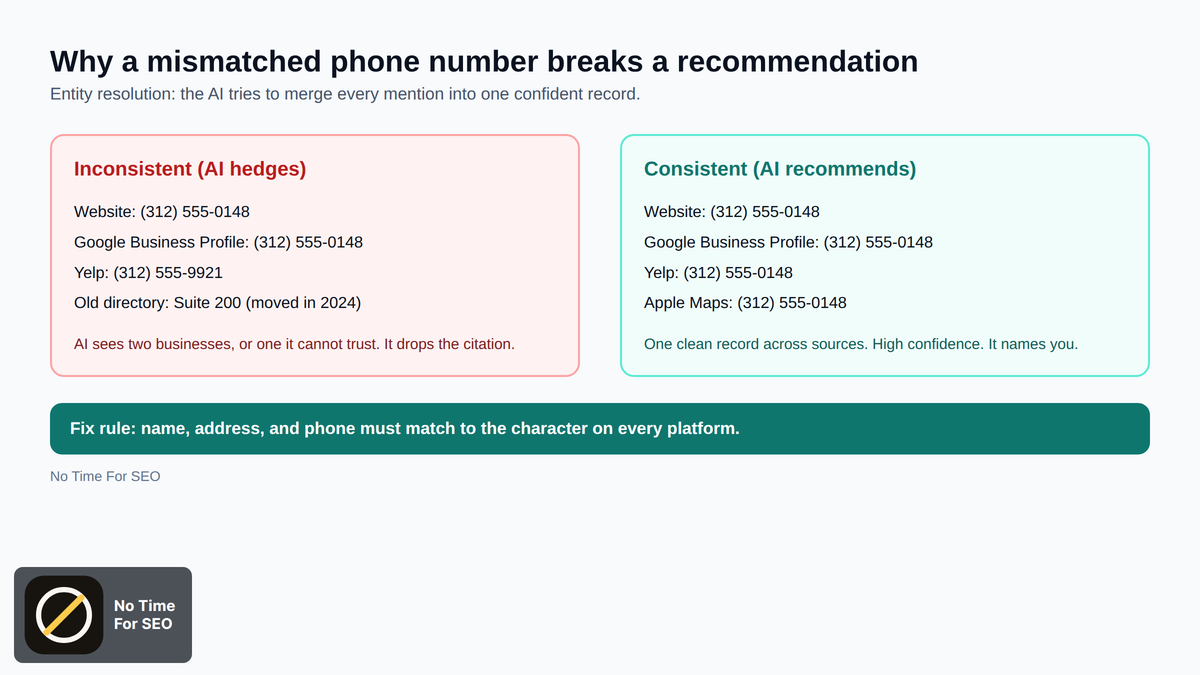
    Yes. Inconsistent name, address, and phone details are one of the fastest ways to lose an AI recommendation. When ChatGPT or Perplexity reads about your business, it runs entity resolution: it tries to merge every mention it finds into one confident record.

    how do ai chatbots choose which businesses to recommend: nap break

    Two different phone numbers, or an old suite number on one directory, reads as either two businesses or one the model cannot trust. AI answers are built with retrieval, meaning the model fetches live sources and pulls facts from them. If those facts conflict, the safest move is to leave you out rather than state something it might get wrong.

    Watch out: The most common killer is a phone number that changed but still lives on an old Yelp or Yellow Pages listing. Search your business name plus your old number and clean up every stale copy you find.

    To fix name, address, and phone consistency, work through this order:

    1. List every place your business is mentioned: Google Business Profile, Bing Places, Apple Maps, Yelp, industry directories, and your own website footer.
    2. Pick one canonical format for your name, address, and phone, down to “Suite” versus “Ste” and spacing.
    3. Correct each listing to match that exact format, one platform at a time.
    4. Search your business name plus any old phone number to find stale copies, and request removal or an update.
    5. Recheck in 30 days, since some directories cache old data for weeks.

    How much do reviews matter for AI business recommendations?

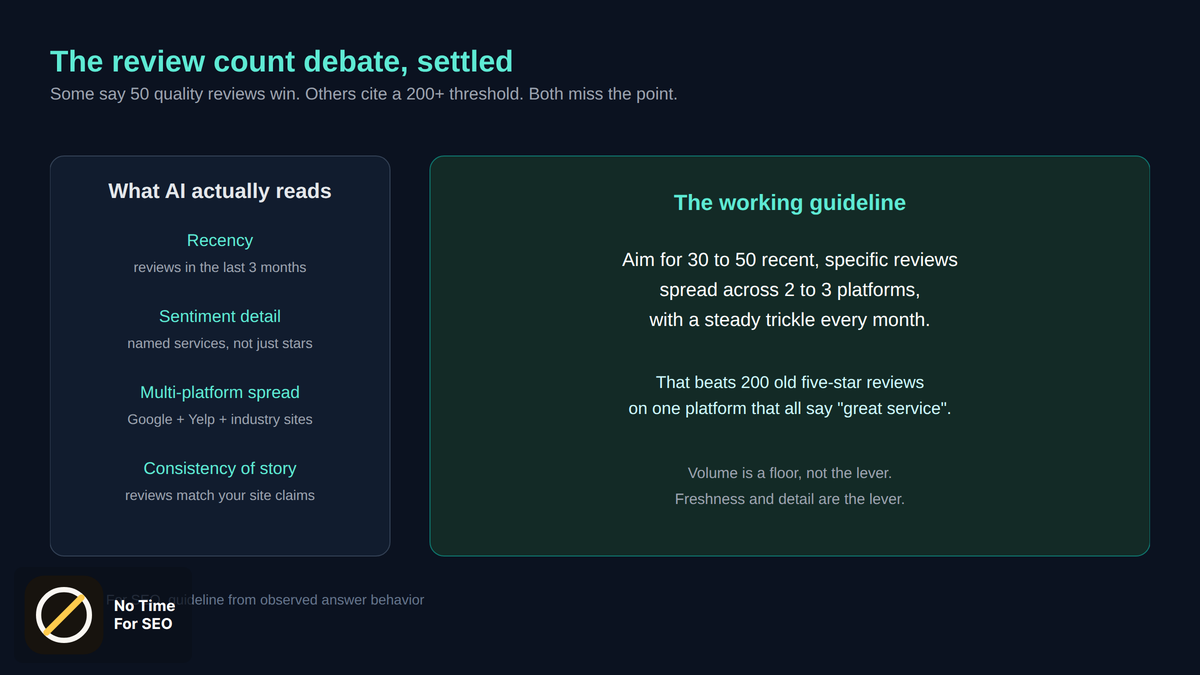
    Reviews matter a lot, but volume is the least important part. AI assistants weigh recency, sentiment detail, and multi-platform spread far more than a raw review count. A business with 40 detailed reviews from the last three months across Google and Yelp is a safer recommendation than one with 200 old five-star reviews on a single platform.

    how do ai chatbots choose which businesses to recommend: review rule

    The advice online contradicts itself here. Some articles claim 50 quality reviews beat 200. Others cite a 100+ or 200+ review threshold. Both are guessing at a number. The defensible guideline, based on how these systems favor fresh, specific, corroborated data: aim for 30 to 50 recent reviews that name real services, spread across two or three platforms, with a steady trickle every month.

    Why recency is the sharpest lever

    A cluster of reviews from the last three months tells the AI your business is active and your reputation is current. A wall of reviews that stops 18 months ago reads as a business that may have declined or closed. Freshness signals liveness, and liveness raises confidence.

    Tip: Ask happy customers to mention the specific service they used, for example “same-day crown” or “furnace repair in January”. Named services give the AI extractable facts it can match to a query. “Highly recommend” gives it nothing.

    Do AI chatbots recommend businesses from directories or from websites?

    AI chatbots use both, and they use them for different jobs. Directories like Google Business Profile, Bing Places, Apple Maps, and Yelp confirm that your business exists and that its core facts are consistent. Your own website supplies the detail: which services you offer, in what area, at what hours.

    Source type Primary job in an AI answer Example
    Authoritative directory Verify the entity exists and its facts match Google Business Profile, Apple Maps, Yelp
    Your website Supply specific, service-level detail and FAQs A dedicated “emergency plumbing” service page
    Third-party authority Corroborate reputation and trust An industry association member listing
    Review platforms Provide recent, specific social proof Fresh Google and Yelp reviews naming services
    AI chatbots pull from four source types, each doing a different job, so a business needs presence across all four.

    This is why owners who only fix their website stay invisible in AI answers, and owners who only claim directories get verified but never recommended for specific needs. You need both halves: the directory is your ID card, the website is your resume.

    FAQ pages get lifted straight into answers

    FAQ-formatted content on your website is quoted directly by AI models, because the format matches how they structure a response. A page that asks “Do you offer same-day appointments?” and answers it in one clear sentence is easy for the machine to lift into its own answer.


    How does brand mention frequency affect AI recommendations?

    Brand mention frequency raises the odds an AI recommends you, because repeated, consistent mentions across independent sources are exactly the corroboration these systems look for. If you appear once, on your own site, the model has a single unverified claim. If you appear with the same facts on your site, in directories, in reviews, and on trusted third-party pages, it has many agreeing sources.

    What our server logs actually measured

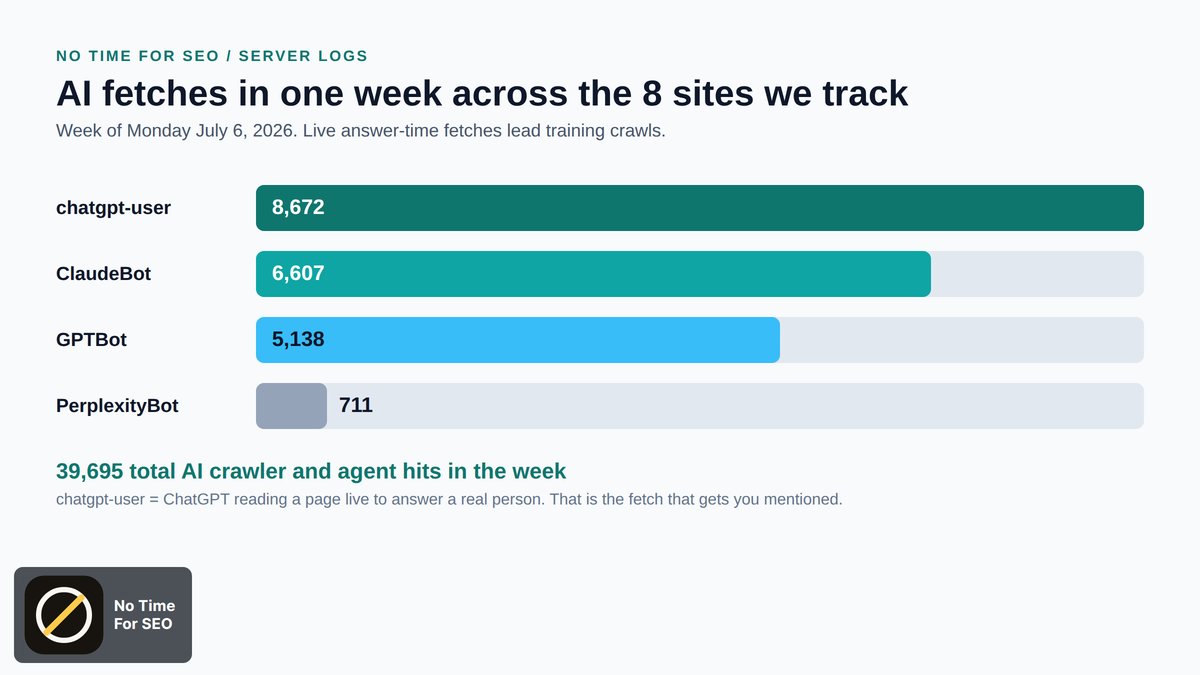
    Across the 8 business sites No Time For SEO tracks, live answer-time fetches from chatgpt-user, the agent ChatGPT uses when it reads a page to answer a real person, hit 8,672 times in one week (week of Monday July 06, 2026). Those are not training crawls. That is the machine reading live to build an answer.

    AI user-agent Fetches in one week What it is doing
    chatgpt-user 8,672 Live answer-time reads for real questions
    ClaudeBot 6,607 Anthropic training crawl
    GPTBot 5,138 OpenAI training crawl
    PerplexityBot 711 Perplexity indexing crawl
    All AI agents and crawlers 39,695 Total across the 8 tracked sites
    AI crawler and agent fetches in one week across the 8 business sites No Time For SEO tracks (week of Monday July 06, 2026).
    how do ai chatbots choose which businesses to recommend: crawler bars
    Where these numbers come from: We match AI user-agents (GPTBot, ClaudeBot, PerplexityBot, OAI-SearchBot, chatgpt-user, and others) in raw nginx server logs across the 8 sites we manage, and aggregate the hits weekly. Training crawlers such as GPTBot and ClaudeBot read to update models. The chatgpt-user agent reads live to answer a specific person, which is why we separate it. Full methodology available on request.

    One honest caveat: heavy crawling is not the same as being recommended. A high fetch count means the machine is reading you. Whether it then cites you depends on the trust signals above. We measure the reading directly; the recommending, we infer from citation checks and client outcomes.


    Can I pay to get my business recommended by ChatGPT?

    No. You cannot pay OpenAI, Anthropic, or Perplexity to make ChatGPT, Claude, or Perplexity recommend your business in an organic answer. There is no “recommended business” ad slot inside the conversational answer today. Anyone selling you a promised AI recommendation or a locked-in citation is overselling, full stop.

    One plain disclosure

    Since this is what we do: No Time For SEO runs search and AI visibility for businesses, so we have a commercial interest in you caring about this. That does not change the mechanics. The work is the same whether you hire anyone or do it yourself: consistent facts, fresh specific reviews, readable structured data, and factual content.


    How do ChatGPT, Perplexity, and Google AI Overviews differ in what they pull?

    ChatGPT, Perplexity, and Google AI Overviews are different systems that lean on different data sources, so appearing in one does not mean appearing in another. ChatGPT blends its training data with live web reads through its browsing agent. Perplexity is retrieval-first, leaning heavily on live search results and citing sources inline. Google AI Overviews sits on top of Google’s own index and Google Business Profile data.

    What our crawl logs show about each

    Our logs show how uneven the attention is. In the same week across our 8 tracked sites, training crawlers hit us 11,745 times (GPTBot 5,138 and ClaudeBot 6,607), versus just 711 PerplexityBot hits. Perplexity reads far less aggressively for training, which fits its retrieval-first design. This is what we measured, not a claim about their internal design.

    System Leans hardest on Practical implication
    ChatGPT Training data plus live reads via its browsing agent Both your published content and consistent facts matter
    Perplexity Live retrieval, cites sources inline Fresh, clearly-sourced pages get quoted
    Google AI Overviews Google’s index and Google Business Profile Traditional local SEO and a strong profile help most
    Google Gemini Google ecosystem plus live search Overlaps with AI Overviews signals
    The leading AI assistants pull from different data sources, so visibility strategy must cover all of them, not just one.

    The takeaway: do not optimize for “the AI”. Optimize for verifiable, consistent facts, because that is the common denominator across every one of these systems.


    Does ranking on page one of Google guarantee an AI recommendation?

    No. Ranking on page one of Google does not guarantee an AI recommendation, because AI recommendation and traditional local SEO are different channels with different signals. You can hold a top-three Google position and still be absent from a ChatGPT answer if your facts conflict across sources or your reviews have gone stale.

    What the payoff looks like when the work is done right

    Strong organic performance and clean facts tend to travel together. A single researched article No Time For SEO wrote for a 5-location dental group earned 52,171 Google impressions in one month while ranking on page one (measured July 2026).

    Client (anonymized) Result measured Non-branded share
    5-location dental group 52,171 Google impressions in one month, page-one article 53% of clicks non-branded
    Trading-education platform 82 of top 100 keywords on page one of Google 63% of clicks non-branded
    Two real client outcomes measured in Google Search Console (July 2026, 28-day windows); names kept anonymous, full data available on request.

    After our takeover, 53% of that dental group’s Google clicks came from non-branded searches: people who did not know the practice name (top-100 query sample, July 2026). Non-branded strength is the tell that a business is being found by people describing a need, which is the exact moment an AI assistant is trying to answer.

    The same pattern on a very different business

    A trading-education platform No Time For SEO runs search for has 82 of its top 100 keywords on page one of Google, and 63% of its clicks are non-branded (July 2026). Our foundational content approach is laid out in our getting-started guide.

    Watch out: Anyone promising a locked-in ranking, citation, or AI recommendation is overselling. These numbers are real client outcomes with anonymized names, not a template. Your results depend on your market, your history, and your own consistency.

    What should a brand-new business with no reviews or citations do first?

    A brand-new business should solve the cold-start problem in a fixed order: establish a verifiable identity before chasing visibility. With zero review or citation history, an AI has nothing to corroborate, so it will skip you rather than risk a wrong recommendation. AI systems would rather hedge or name an established competitor than vouch for a business they cannot verify.

    Work this sequence in your first month:

    1. Claim your Google Business Profile, Bing Places, and Apple Maps listings with identical name, address, and phone.
    2. Publish a simple website with one factual page per service, plus a short FAQ that answers real customer questions.
    3. Add LocalBusiness schema to your homepage and FAQPage schema to your FAQ, so the facts are machine-readable.
    4. Earn your first 10 to 15 reviews from real customers who name the specific service they received.
    5. Get one listing on a respected industry directory or association to add a trusted third-party mention.

    This is the whole game for a new business: become an entity that agrees with itself everywhere it appears. Once the facts line up across four or five independent sources, the AI has the corroboration it needs to start recommending you.


    Your do-this-now checklist for this week

    Here is the short list a busy owner can finish this week to become the business an AI can confidently recommend:

    1. Audit your name, address, and phone across Google Business Profile, Bing Places, Apple Maps, and Yelp, and fix every mismatch to one exact format.
    2. Search your business name plus any old phone number, then request removal of stale listings.
    3. Ask five recent customers for a review that names the specific service they used.
    4. Add LocalBusiness schema to your homepage and FAQPage schema to your FAQ page.
    5. Write one plain, factual page for each core service, with a short FAQ underneath.
    6. Claim one listing on a trusted industry directory to add a third-party mention.

    Frequently asked questions

    How do AI chatbots choose which businesses to recommend?

    AI chatbots recommend the business whose facts they can verify across the most independent sources with the least contradiction. They decompose the question, retrieve live sources, cross-check your name, address, and phone against directories and reviews, then recommend the highest-confidence match. Verifiable consistency beats marketing polish every time.

    What ranking factors do AI assistants use to pick a business?

    AI assistants weigh NAP consistency across platforms, review recency and detail, structured data they can read, presence in authoritative directories, specific website content, and third-party citations. No single factor decides it. The systems stack these into a confidence score and recommend the highest-confidence match for the query.

    How much do reviews matter for AI business recommendations?

    Reviews matter a lot, but recency, sentiment detail, and multi-platform spread matter more than raw volume. Aim for 30 to 50 recent reviews that name specific services across two or three platforms, refreshed monthly. That beats 200 old, generic five-star reviews on a single platform.

    Can I pay to get my business recommended by ChatGPT?

    No. There is no paid slot to make ChatGPT, Claude, or Perplexity recommend your business in an organic answer. Anyone promising an AI recommendation or citation is overselling. You earn recommendations by building verifiable trust signals: consistent facts, fresh specific reviews, and machine-readable content.

    Does inconsistent name, address, and phone hurt my AI recommendations?

    Yes. Inconsistent name, address, and phone details break the entity resolution AI systems run to merge your mentions into one trusted record. Conflicting facts, such as two phone numbers or a stale address, lower the model’s confidence, so it hedges or recommends a competitor whose facts line up cleanly.

    Do AI chatbots recommend businesses from directories or from websites?

    Both. Directories like Google Business Profile and Apple Maps verify that your business exists and its facts are consistent. Your website supplies service-level detail and FAQs the AI can quote. You need both: the directory is the ID card, the website is the resume.

    How does brand mention frequency affect AI recommendations?

    Repeated, consistent brand mentions across independent sources give AI systems the corroboration they need to recommend you with confidence. Appearing once on your own site is a single unverified claim. Appearing with matching facts on your site, in directories, in reviews, and on trusted third-party pages is strong corroboration.


  • Why ChatGPT Doesn’t Know Your Business Exists

    ChatGPT does not know your business exists because it builds its picture of a company from what the wider web says about that company, not from your website alone. Your business has probably not built enough consistent third-party mentions yet for ChatGPT to treat it as a known, described entity.

    why does chatgpt not know my business: two paths

    That is the short version. Here is a number most articles cannot give you. In the week of Monday, July 6, 2026, ChatGPT’s live-reading agent fetched pages 8,672 times across the 8 business sites No Time For SEO tracks in raw web server logs.

    Tip: The agent doing that live reading is labeled chatgpt-user in server logs. ChatGPT runs it when it reads a page in real time to answer a real person’s question, separate from the crawlers that gather training data.

    So when ChatGPT says it has no information about your company, the problem is not that it never looks. The problem is what it finds when it does. This guide gives you three things the other ten articles on this query do not:

    • A set of exact prompts to run in ChatGPT this week to diagnose your specific problem.
    • Two real before-and-after copy rewrites, not abstract advice.
    • A bounded five-day action plan with time estimates.

    Full disclosure up front: No Time For SEO sells this work as a service, so we have a stake here. Everything below works whether you hire anyone or do it yourself.


    How ChatGPT decides what it “knows” about your business

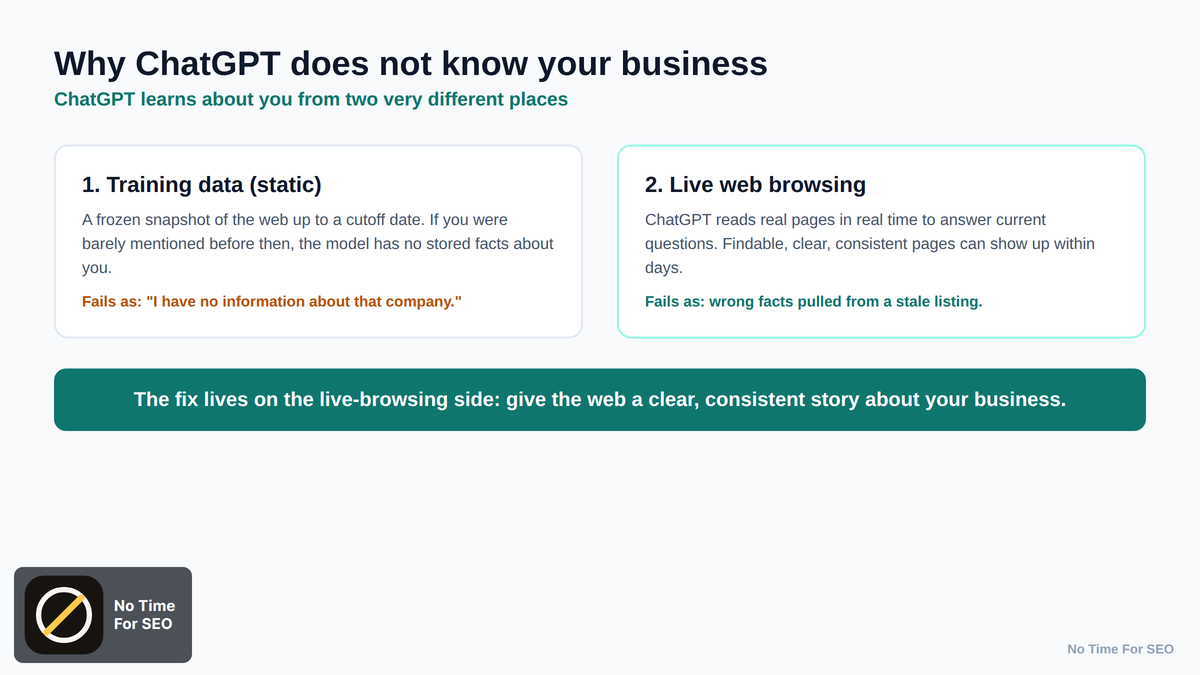
    ChatGPT decides what it knows about your business from two separate sources, and they behave nothing alike. Confusing them is the single biggest reason owners misdiagnose why ChatGPT ignores their business.

    • Training data: a frozen snapshot of the public web and licensed text, gathered up to a cutoff date. If you were barely mentioned online before that cutoff, the base model has no stored facts about you.
    • Live web browsing: when ChatGPT judges that a question needs current information, it searches and reads pages in real time. This is where those 8,672 live fetches came from.

    The two sources answer different questions and fail in different ways. The table below shows how each one behaves for a business owner.

    Table 1: How ChatGPT’s two knowledge sources differ for a business owner
    Dimension Training data (static) Live web browsing
    When it applies General or historical questions Current, local, or “look this up” questions
    Recency Frozen at the knowledge cutoff As current as the pages it fetches
    Your new page from last week Invisible until a future model is trained Findable once search engines index it
    Failure mode “I have no information about that company” Wrong facts pulled from a stale directory

    Takeaway: a brand-new page can reach ChatGPT through live browsing within days, but it will not enter the trained model until OpenAI ships a future version.

    Does ChatGPT only know businesses in its training data?

    No, ChatGPT does not only know businesses in its training data. When ChatGPT browses the live web to answer a question, it can surface a company it has no trained memory of, as long as that company has pages a search can find and read.

    Tip: Training data sets ChatGPT’s default assumptions; live browsing can override them. The catch is that ChatGPT only browses when it decides the question warrants it, and it still trusts what it reads based on how consistent and credible the sources look.

    Why ChatGPT says it has “no information” about your company

    ChatGPT says it has no information about your company when the public web has not told a clear, repeated story about who you are and what you do. ChatGPT weighs what other sites say about you more heavily than what your own site says about itself.

    Tip: Your website claims you are the best; so does every competitor’s website. To a system working out what is true, self-description is the weakest possible signal. That is why ChatGPT looks for the same facts echoed across independent sites before it trusts them.

    This is also why traditional SEO and AI search visibility are not the same game. Traditional SEO leans on backlinks and rankings. AI search visibility leans on semantic consensus: many independent sources describing your business in the same concrete terms.

    A trading-education platform we run search for has 82 of its top 100 keywords on page one of Google, and 63% of its clicks come from non-branded searches (Google Search Console top-100 query sample, 28-day window ending July 12, 2026).

    You can rank on Google and still be invisible to ChatGPT if the web has no consistent description of what you do. That trading platform’s strong, non-branded footprint is exactly the raw material AI systems need: both channels reward the same underlying clarity, even though they measure it differently.

    Why does ChatGPT weigh third-party mentions more than my own website?

    ChatGPT weighs third-party mentions more heavily because they are harder to fake than self-description. A news article, a directory entry, or a review profile represents a second party agreeing with your claims. When five independent sites describe your business the same way, that agreement is the semantic consensus a model can safely extract and repeat.


    Is your business too new or too small for ChatGPT to know about it?

    Yes, a brand-new or very small business can simply lack enough public material for ChatGPT to describe it, and that is the most common honest reason. ChatGPT cannot summarize a company the web has barely written about.

    Watch out: Do not wait years hoping ChatGPT catches up on its own. Live browsing means a clear, consistent footprint can start showing up in answers within days of being indexed, not after the next model release.

    But “too new” is often a misdiagnosis. Plenty of small businesses are old enough and have a website, yet ChatGPT still draws a blank because their footprint is thin and inconsistent rather than absent. A three-year-old plumber with one unclaimed Google Business Profile and a vague homepage has an age problem in name only; the real barrier is that nothing on the web says clearly what the business does and where.

    Is my business too new for ChatGPT to know about it?

    Your business may be too new only if it has almost no public presence: no complete Google Business Profile, few directory listings, and no third-party mentions. Age itself is not the barrier. A one-month-old business with a complete profile, a clear website, and three or four consistent listings can appear in ChatGPT’s live-browsed answers before an established business that never cleaned up its scattered information.


    Diagnose it: the exact prompts to run in ChatGPT this week

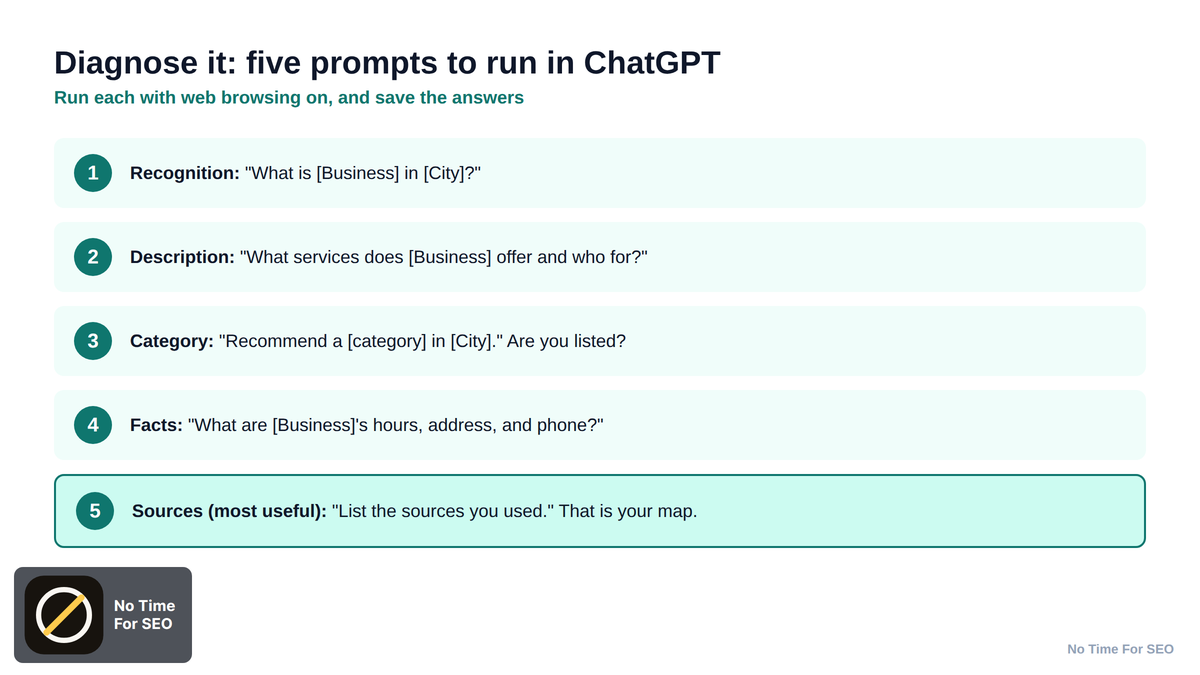
    Before you fix anything, find out precisely how ChatGPT sees your business right now. Run these five prompts in ChatGPT with web browsing enabled, and write down the answers verbatim. This is the diagnostic step no other guide gives you.

    1. Test raw recognition: Type “What is [Business Name] in [City]?” If ChatGPT says it has no information, you have a visibility problem, not an accuracy problem.
    2. Test the description: Type “What services does [Business Name] offer and who are its customers?” Vague or wrong answers show the web is describing you badly.
    3. Test the category: Type “Recommend a [your category, e.g. family dentist] in [City].” If you are absent, you are missing from the consensus for your own category.
    4. Test the facts: Type “What are [Business Name]’s hours, address, and phone number?” Compare every field against reality to catch stale data.
    5. Test the source trail: Add “List the sources you used.” The URLs ChatGPT cites tell you exactly which pages shape its answer.
    why does chatgpt not know my business: diagnose flow

    That fifth prompt is the most useful and the least known. The sources ChatGPT lists are your map. If it cites a stale Yelp page with your old address, you know precisely what to fix. If it cites nothing about you, the web is silent and your job is to give it something to read.

    Tip: Run the same five prompts in Perplexity and Google AI Overviews too. ChatGPT, Perplexity, and Google AI Overviews are different systems that pull from different sources and will disagree. Fixing one does not automatically fix the others.

    How to tell ChatGPT what your business does (rewrite vague copy)

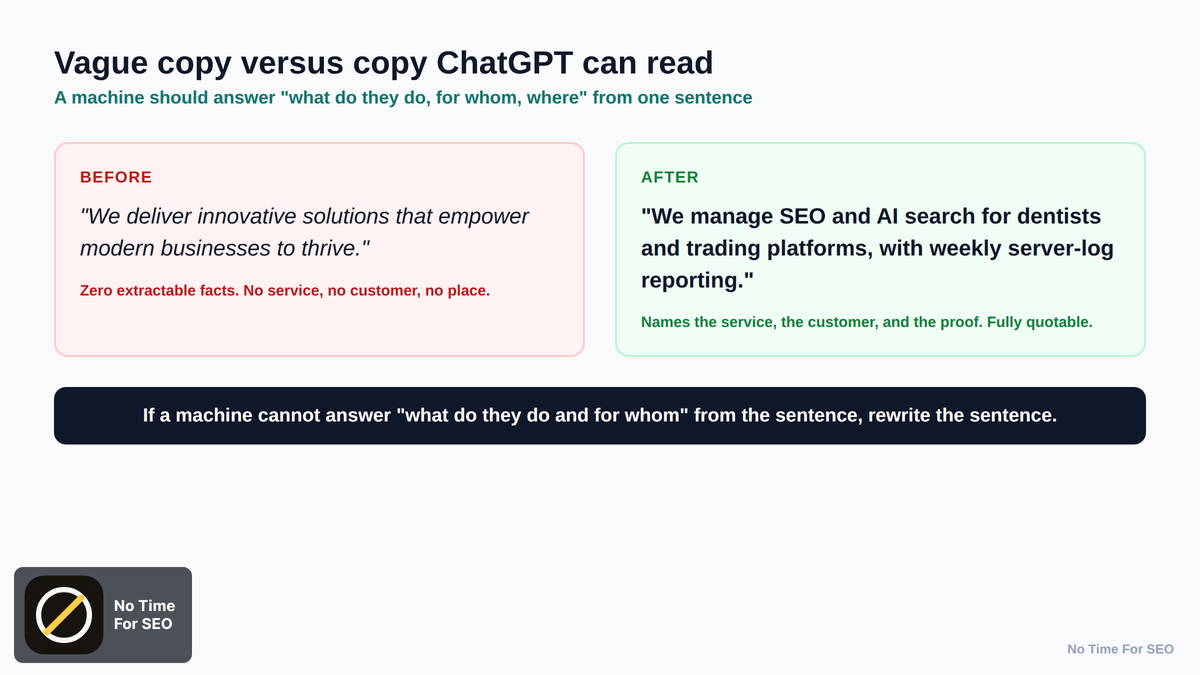
    You tell ChatGPT what your business does by publishing specific, concrete descriptions across your own site and every third-party profile, using the same words everywhere. Vague phrases like “innovative solutions” and “empowering businesses” carry zero extractable meaning, so ChatGPT cannot repeat them as facts. The fix is to name the exact service, the exact customer, and the exact place.

    Table 2: Vague copy versus AI-legible copy, two worked rewrites
    Before (vague, unextractable) After (specific, AI-legible)
    “We deliver innovative solutions that empower modern businesses to thrive.” “We manage SEO and AI search visibility for dentists, trading-education platforms, and local service businesses, with weekly server-log reporting.”
    “A trusted partner for all your smile needs.” “Riverside Family Dental is a five-location dental group in Austin offering cleanings, implants, Invisalign, and emergency care, open Saturdays.”

    Takeaway: every rewrite names the service, the customer, and the place, so ChatGPT can lift a whole sentence and attribute it to you.

    why does chatgpt not know my business: before after

    Notice what the “after” versions do. They contain nouns a model can index: dentists, implants, Austin, Saturdays. A machine reading your page should answer “what do they do and who for” from a single sentence. If it cannot, rewrite the sentence.

    How do I tell ChatGPT what my business does?

    Tell ChatGPT what your business does by writing one plain sentence that names your service, your customer, and your location, then repeating that same description on your homepage, your Google Business Profile, and your directory listings. ChatGPT reads these public sources and repeats the description it sees most consistently, so identical wording across sites is what makes the message stick.


    The signals that actually move ChatGPT, ranked by leverage

    The signals below are the levers that change what ChatGPT can say about you. Nobody outside OpenAI knows the exact weighting, so treat this as observed behavior and our own measurements, not insider rules.

    Table 3: What ChatGPT reads about your business, and what to do about each
    Signal What it tells ChatGPT Your action
    Google Business Profile Baseline identity: name, address, phone, category, hours Claim it, complete every field, pick the exact category
    Third-party mentions Independent confirmation of who you are Earn directory, news, and review-site listings
    Structured data / schema markup Machine-readable labels for your business type and offerings Add LocalBusiness or Organization schema
    Dedicated page per question A thorough answer beats a passing mention Build one page that fully answers each key question
    Entity consistency Same name and details everywhere means one real business Match name, address, and description across all sites

    Takeaway: a complete Google Business Profile plus consistent third-party listings is the baseline; schema and dedicated pages are the multipliers.

    • Structured data (schema markup): invisible code that labels your content so machines can read it. It explicitly tells AI systems “this is a dental practice, here are its services, here are its hours.”
    • A dedicated page per question: a page that thoroughly answers one question beats a passing mention buried in a paragraph. If people ask ChatGPT “does [business] do emergency visits,” you want a page whose whole job is answering that.
    Tip: Write FAQ-style content in the exact words people say to ChatGPT. Not “Our Service Offerings” but “Do you take walk-in emergency appointments on weekends?” Match the question and you match the query.

    One researched article we wrote for a five-location dental group earned 52,171 Google impressions in one month while ranking on page one (Google Search Console, July 2026, client kept anonymous).

    That is one page, answering real questions in plain language. Does the thorough-page approach pay off? The impressions above say it can, though nobody can promise a specific number for your page.


    Multi-location and franchise businesses: the consistency trap

    Multi-location and franchise businesses fail with ChatGPT most often because their information drifts apart across locations, not because any single listing is wrong. Every new location, listing, or manager is a chance for the name, category, or hours to diverge.

    Watch out: Old listings you forgot about are the usual culprit. A closed location or a former address still live on a directory will feed ChatGPT wrong facts long after you have moved on. Hunt them down and correct or remove them.

    The fix is a single source of truth. Keep one master record of exact name, address, phone, category, and description for every location, then push that identical text everywhere. When ChatGPT reads ten listings that agree, it becomes confident; when it reads ten that disagree, it hedges or picks the wrong one.

    After our takeover, 53% of that five-location dental group’s Google clicks came from non-branded searches, meaning people who did not already know the practice name (top-100 query sample, Google Search Console, July 2026).

    Consistent, well-described locations get discovered by strangers, which is exactly the audience AI recommendations reach.


    Why ChatGPT gives wrong information, and how to correct it

    ChatGPT gives wrong information about your business when it reads outdated or conflicting sources and stitches them into a confident-sounding answer. It is not lying; it is repeating the most consistent story the web tells, and if that story is stale, the answer is stale.

    Why does ChatGPT give wrong information about my business?

    ChatGPT gives wrong information about your business because it pulls from whatever public sources it can find, and old directory entries, closed-location listings, and outdated review profiles often outrank your current site in its view. When your correct information lives in fewer or weaker places than the wrong information, the wrong version wins by weight of repetition.

    How do I correct false information ChatGPT says about my business?

    You correct false information by fixing the sources ChatGPT reads, not by arguing with ChatGPT in the chat window. Corrections you type into a conversation do not persist or change the model. Work through these steps in order.

    1. Find the sources: Ask ChatGPT to list the sources behind the wrong answer, then open each one.
    2. Fix the origin: Update the incorrect field on your Google Business Profile, your website, and any directory showing stale data.
    3. Flush the duplicates: Correct or remove old listings, closed-location pages, and abandoned profiles that repeat the error.
    4. Publish the truth clearly: Put the correct fact in plain text on a page you control, so the right version has the strongest, most consistent source.
    5. Re-test after indexing: Wait for search engines to re-crawl, then run your diagnostic prompts again to confirm the change.
    Tip: For genuinely defamatory or harmful errors, OpenAI provides feedback and reporting channels inside ChatGPT. Use them, but the durable fix is always upstream: change what the web says, and the answer follows.

    How long until ChatGPT’s answers actually change?

    ChatGPT’s answers change on two very different clocks, and knowing which one applies keeps you from panicking too early. No other guide on this query spells out this lag, so here is the honest picture from what we observe.

    • Live browsing: the gate is search-engine indexing. Once a new or corrected page is indexed and ChatGPT chooses to browse for that question, the fresh information can appear in days to a few weeks. This is the fast path.
    • The trained model: the wait is measured in model releases, not days. A fact that only lives on your brand-new page will not enter ChatGPT’s static memory until OpenAI trains and ships a future version.

    Nobody outside OpenAI knows that training schedule, so we never promise a date. Anyone who promises you a fixed position or a locked-in timeline is overselling.

    why does chatgpt not know my business: crawler week

    Here is why the fast path is worth trusting: the crawlers are genuinely active. In the week of Monday, July 6, 2026, No Time For SEO recorded 39,695 AI crawler and agent hits across the 8 sites it tracks in server logs.

    Training crawlers hit those sites 11,745 times that week (GPTBot 5,138, ClaudeBot 6,607) against 711 PerplexityBot hits. The machines are reading constantly.

    Give them something clear to read and the live path moves quickly. That speed is why the one-week plan below is worth starting now rather than later.

    Where these numbers come from: All crawler and agent figures come from No Time For SEO’s own nginx server-log analysis for the week of Monday, July 6, 2026, matching user-agent strings (GPTBot, ClaudeBot, PerplexityBot, OAI-SearchBot, chatgpt-user, and others) across the 8 business sites we track, aggregated weekly. The Google impression and click figures come from Google Search Console, verified July 2026, using each property’s top-100 query sample over a 28-day window. Client names stay anonymous; full data is available on request.

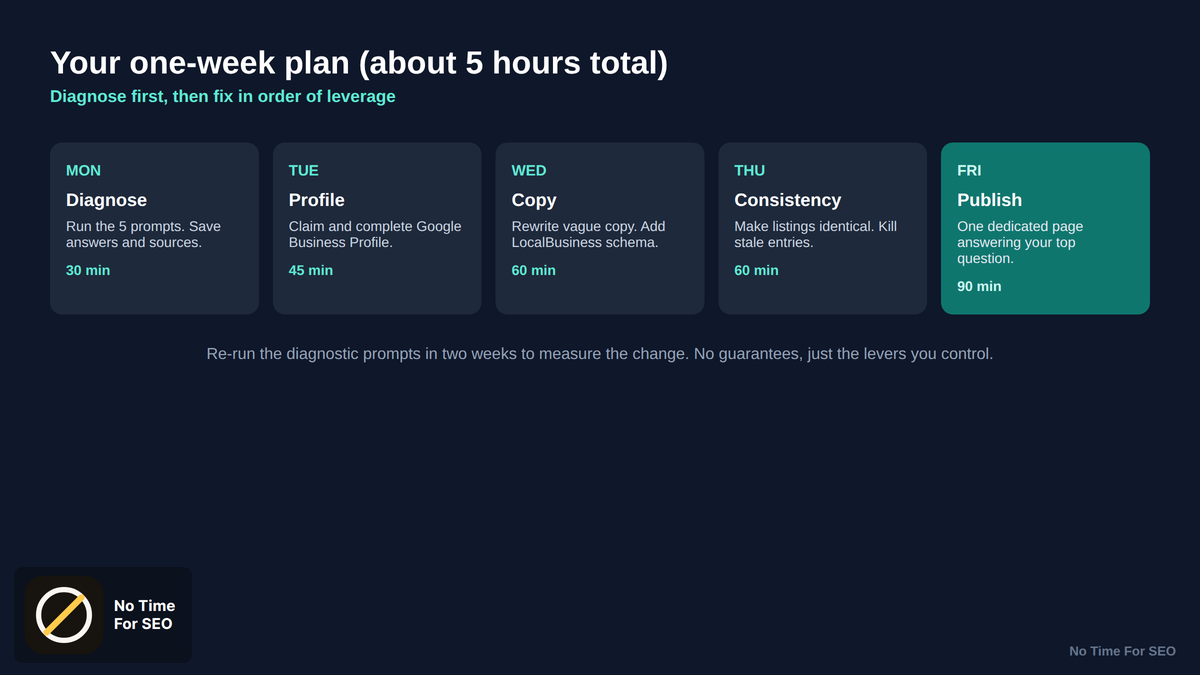
    Your one-week action plan to get ChatGPT to know your business

    Here is exactly what to do this week, with time estimates, so ChatGPT starts describing your business correctly. Do the diagnosis first, then work the fixes in order of leverage.

    why does chatgpt not know my business: one week plan
    1. Monday, diagnose (30 minutes): Run the five diagnostic prompts in ChatGPT, Perplexity, and Google AI Overviews. Save every answer and every source URL.
    2. Tuesday, fix your profile (45 minutes): Claim and complete your Google Business Profile. Fill name, address, phone, category, service area, and hours. Match your website exactly.
    3. Wednesday, rewrite your copy (60 minutes): Replace vague homepage and about-page language with specific sentences naming your service, customer, and location. Add LocalBusiness schema.
    4. Thursday, fix consistency (60 minutes): Audit your top directory and review listings. Make the business name and description identical everywhere. Correct or remove stale and closed-location entries.
    5. Friday, publish one dedicated page (90 minutes): Build one page that thoroughly answers your single most-asked customer question, in the exact words people use, and link it from your homepage.

    That is roughly five hours of focused work. It will not put you in ChatGPT’s trained memory, since only a future model release does that, and it does not promise you a citation.

    Tip: Link your cornerstone page from your homepage the way we describe in our getting-started notes so the crawlers find it fast.

    What it does is give the live web a clear, consistent, machine-readable story about your business, which is the one thing entirely inside your control. Re-run your diagnostic prompts in two weeks to measure the change.


    Frequently asked questions

    Why does ChatGPT say it has no information about my company?

    ChatGPT says it has no information about your company when the public web has not told a clear, repeated story about who you are and what you do. ChatGPT relies on third-party mentions and consistent listings, not your website alone. If those are thin, absent, or contradictory, ChatGPT has nothing confident to extract and repeat, so it declines to answer.

    Does ChatGPT only know businesses in its training data?

    No. ChatGPT can surface businesses absent from its training data by browsing the live web when it decides a question needs current information. Training data sets its default knowledge; live browsing can override it, as long as your business has findable, readable, consistent pages for the search to reach.

    Is my business too new for ChatGPT to know about it?

    Your business is too new only if it has almost no public presence. Age itself is not the barrier. A one-month-old business with a complete Google Business Profile, a clear website, and a few consistent directory listings can appear in live-browsed answers before an older business whose information is scattered and vague.

    How do I tell ChatGPT what my business does?

    Write one plain sentence naming your service, your customer, and your location, then repeat that identical description on your homepage, your Google Business Profile, and your directory listings. ChatGPT reads these public sources and repeats the most consistent description, so matching wording across sites is what makes the message land.

    How do I correct false information ChatGPT says about my business?

    Correct false information by fixing the sources ChatGPT reads, not by arguing in the chat. Ask ChatGPT to list its sources, update the incorrect fields on your profile, website, and directories, remove stale or closed-location listings, then re-test once search engines re-crawl. Corrections typed into a conversation do not persist.

    Will fixing my website make ChatGPT recommend my business?

    Not on its own, and nobody can promise a ChatGPT recommendation, because nobody outside OpenAI knows the exact ranking rules. Anyone promising a fixed, locked-in position is overselling. A clear, consistent, well-described public footprint is the strongest lever you control, and it measurably raises your odds, but it is odds, not a promise.

  • How to Get Your Business Mentioned in ChatGPT

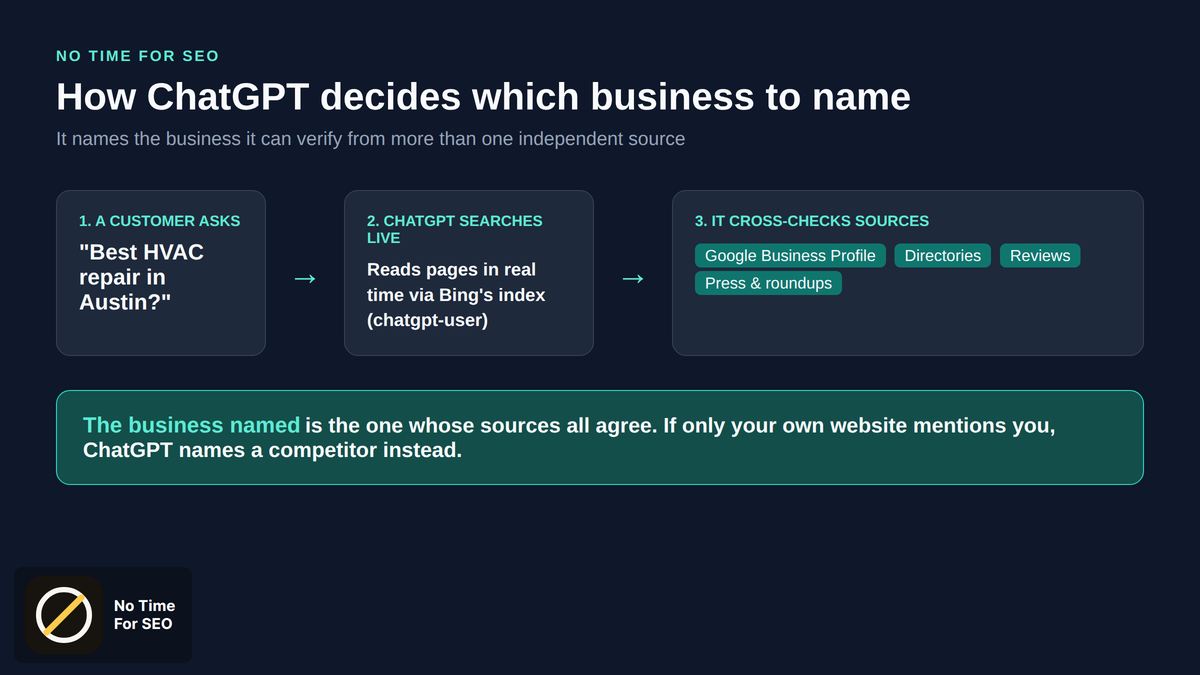
    ChatGPT mentions the businesses it can verify from more than one independent source. If your business only lives on your own website, ChatGPT has nothing to cross-check, so it names a competitor that directories, review platforms, and articles all describe the same way. That is the whole mechanic, and a solo owner can fix it without a marketing team.

    how to get my business mentioned in chatgpt: sourcing flow

    No Time For SEO reads raw web server logs for the 8 business sites we track. In the week of Monday July 6, 2026, those sites took 39,695 AI crawler and agent hits. Of those, 8,672 came from chatgpt-user, the agent ChatGPT sends when it reads a page live to answer a real person.

    Tip: Nobody outside OpenAI or Anthropic knows the exact ranking rules. Everything below is either what we measured in our own logs or what we believe from watching behavior, and this guide says which is which. Anyone promising you a guaranteed spot in ChatGPT is overselling.

    This guide is the owner-to-owner playbook, not an agency pitch. You get the exact prompts to test your current visibility, copy-paste schema code, a realistic timeline, and a checklist to run this week. Every number here comes from our own server logs, from Google Search Console, or from a named source.


    Does ChatGPT pull business recommendations from live web search or training data?

    ChatGPT pulls business recommendations from two places, and for local questions live web search does most of the work today.

    • Training data: a static snapshot frozen months ago. It lets ChatGPT describe well-known national brands without searching, but a new or local business rarely sits inside it.
    • Live web search: ChatGPT reads pages in real time through Bing’s index before answering. This is where a small business actually gets picked up, and it leaves a fingerprint in your server logs.

    Here is what that fingerprint looked like for one week across the 8 sites we track. ChatGPT’s live answer-time agent, chatgpt-user, fetched pages far more than any training crawler, which tells you live search is doing the heavy lifting.

    AI crawler and agent fetches in one week (week of Mon Jul 6, 2026) across the 8 business sites No Time For SEO tracks in server logs.
    User-agent What it does Fetches in the week
    chatgpt-user ChatGPT reading a page live to answer a person 8,672
    ClaudeBot Anthropic training crawl (Claude) 6,607
    GPTBot OpenAI training crawl (future models) 5,138
    PerplexityBot Perplexity crawl 711
    All AI crawlers and agents combined 39,695

    Takeaway: across the 8 sites we track, live answer-time fetches from chatgpt-user (8,672) outnumbered OpenAI’s training crawler GPTBot (5,138) in the same week, so the page ChatGPT reads when a customer asks is your live page, not a cached memory.

    how to get my business mentioned in chatgpt: crawler bars

    The practical lesson is blunt: ChatGPT reads your live site. If that page is slow, blocked, or thin, ChatGPT drops it and reads a competitor instead. We keep our tracked pages returning in well under half a second for exactly this reason.

    Watch out: ChatGPT’s live search reads the open web through Bing’s index. If Bing cannot find your pages, ChatGPT’s live layer usually cannot either. Search your business name on Bing before you blame ChatGPT.

    Why does ChatGPT not mention my business when I ask about my industry?

    ChatGPT does not mention your business when it cannot confirm what you do from sources other than your own website. A single self-published claim is not enough for ChatGPT to stake a recommendation on. It wants agreement across directories, review sites, and articles before it puts your name in an answer.

    1. No third-party footprint: your business exists only on your own domain, so nothing corroborates it.
    2. Inconsistent NAP: your name, address, and phone number disagree across listings, so no source clearly matches another.
    3. No plain statement of what you do: your website never says, in extractable sentences, exactly what you sell and who you serve.

    Entity clarity is the fix for the third gap. Entity clarity means it is unambiguous what your business is, what it sells, and where it operates. If a human skimming your homepage cannot say in one sentence what you do and who for, ChatGPT cannot either.

    Tip: Write one sentence you want ChatGPT to say about you: “[Business] is a [category] in [city] that helps [who] with [what].” Put that exact sentence on your homepage and your Google Business Profile. Consistency is what gets cross-checked.

    What makes ChatGPT recommend one local business over another?

    For local businesses, ChatGPT recommends the option with the clearest, most consistent, most corroborated public record. Two shops can be equally good in real life, and ChatGPT names the one whose Google Business Profile, directory listings, and reviews all line up and say the same thing.

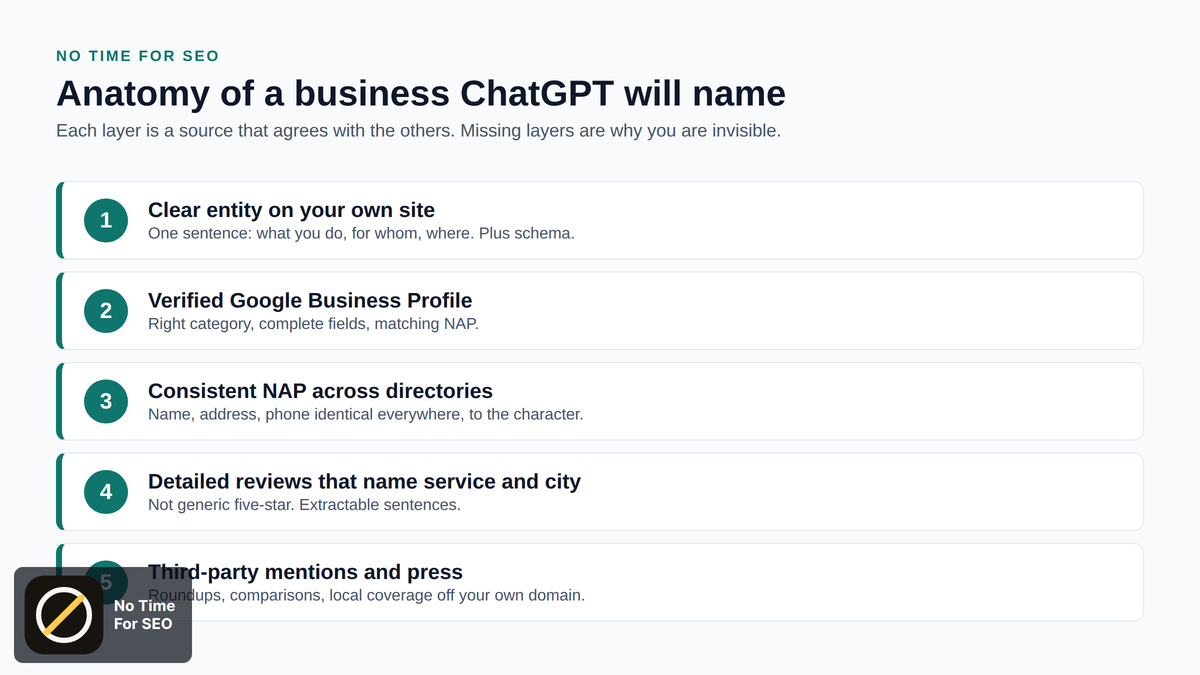
    how to get my business mentioned in chatgpt: anatomy of a mention

    Google Business Profile is the anchor for local visibility. It feeds Google’s local data, which flows into the directories and maps that AI systems read. An unverified or half-filled profile is the single most common reason a real local business is invisible to AI answers.

    1. Claim and verify the listing so you control it, not an auto-generated stub.
    2. Set the exact primary category that matches what a customer would type, not a vague one.
    3. Fill every field: hours, service area, services, attributes, and a description using your one-sentence entity statement.
    4. Match your NAP so the name, address, and phone number are identical to your website, to the character.
    5. Post and reply regularly so the profile reads as active, not abandoned.

    NAP consistency deserves its own line. Keep your name, address, and phone number identical across every directory and listing. “Suite 200” on one site and “Ste 200” on another can be read as two different places, which splits your evidence and weakens every source at once.

    Watch out: Local visibility is not the same problem as national brand visibility. A national brand often sits in ChatGPT’s training data already; a local business is won or lost on Google Business Profile, NAP consistency, and local directories, which is where a solo owner can move fastest.

    How do third-party mentions affect whether ChatGPT names my business?

    Third-party mentions are the strongest lever a small business has for ChatGPT visibility. A mention is any place other than your own site that describes your business, and ChatGPT treats agreement across these as evidence you are real and relevant.

    • A directory or listing site
    • A review platform
    • A news article or local press piece
    • A “best [service] in [city]” roundup
    • A comparison or alternatives post

    This is corroboration, not link-building. The old SEO goal was link authority; the AI goal is consensus, meaning many independent sources describing you the same way. One trade-directory listing plus two roundups plus consistent reviews can outweigh a single strong link, because ChatGPT is checking whether the web agrees about you.

    1. List on the core directories for your category and city, with identical NAP every time.
    2. Earn roundup and comparison inclusions (“best [service] in [city]”) by pitching the writers who publish them.
    3. Get press and PR coverage from local outlets and niche industry blogs, even small ones.
    4. Publish expert content elsewhere: a guest guide, a podcast, or a genuinely useful forum answer.

    We see the payoff of corroborated, well-covered content in Google data too, which is the same open web ChatGPT reads. One researched article we wrote for a 5-location dental group earned 52,171 Google impressions in a single month while ranking on page one, measured in July 2026 from that page’s Search Console report.

    Tip: Being nameable to strangers is exactly what an AI recommendation is. After our takeover of that dental group, 53% of its Google clicks came from non-branded searches, meaning people who did not know the practice name, measured across the top-100 query sample in July 2026.

    Do I need reviews on Yelp and G2 for ChatGPT to recommend me?

    You do not strictly need Yelp or G2, but reviews on the platforms that matter for your category make ChatGPT far more confident naming you. Reviews are third-party corroboration with sentiment attached, so pick the platforms your customers actually use.

    • Local service business: Google and Yelp reviews carry the most weight.
    • Software or B2B: G2 and Capterra are the platforms ChatGPT leans on.
    • Restaurants and hospitality: Google, Yelp, and TripAdvisor.

    Detailed reviews outperform generic five-star reviews for AI visibility. “Great service, five stars” gives ChatGPT nothing to extract. “They repaired our commercial HVAC in Austin the same day and explained the fix” names the service, the city, and the outcome, which is exactly the kind of sentence an AI can lift into an answer.

    Why a detailed review beats a generic five-star review as source material an AI can extract.
    Attribute Generic five-star review Detailed review
    Extractable facts None Service, location, outcome
    Entity reinforcement Weak Repeats what you do and where
    Answers a real question No Yes (“who fixes X in [city]”)
    Value to ChatGPT Low High

    Takeaway: ask happy customers to name the specific service and the city in their review, because a review that states what you did and where is worth more to ChatGPT than ten reviews that only say “five stars.”

    Tip: When you ask for a review, prompt with one question: “What did we do and where?” That single nudge turns a generic star rating into an extractable sentence ChatGPT can quote.

    Add schema markup so ChatGPT can extract your facts

    Schema markup is code that states your business facts in a format machines read directly, so nothing has to be inferred from prose. It is also called structured data or JSON-LD. Most guides tell you to add it and never show the code, so here is a copy-paste LocalBusiness block; replace the values with yours.

    <script type="application/ld+json">
    {
      "@context": "https://schema.org",
      "@type": "LocalBusiness",
      "name": "Acme HVAC Repair",
      "description": "Commercial and residential HVAC repair in Austin, Texas.",
      "url": "https://www.acmehvac.com",
      "telephone": "+1-512-555-0142",
      "address": {
        "@type": "PostalAddress",
        "streetAddress": "200 Congress Ave, Ste 200",
        "addressLocality": "Austin",
        "addressRegion": "TX",
        "postalCode": "78701",
        "addressCountry": "US"
      },
      "areaServed": "Austin, TX",
      "openingHours": "Mo-Fr 08:00-18:00",
      "priceRange": "$$"
    }
    </script>

    Install it in three steps a non-technical owner can do without help.

    1. Edit the values so the name, address, and phone match your Google Business Profile exactly.
    2. Paste it into your site: in WordPress use a plugin’s schema field or a header-scripts box; on Squarespace or Wix use a code block or the site-wide code injection area.
    3. Validate it by running the live URL through Google’s Rich Results Test and confirming the LocalBusiness fields read back correctly.

    Schema does not force ChatGPT to name you. It removes ambiguity, which is a real edge when your data is otherwise clean and consistent. Add it once, keep it matching your other listings, and move on.

    Watch out: If your site already generates schema through an SEO plugin, do not paste a second block that fights it with different values. One clean, correct LocalBusiness entity beats two that disagree.

    Write content in a direct-answer format ChatGPT can lift

    Write so a single sentence answers a real question with no surrounding context needed. AI systems extract standalone sentences and attribute them, so a direct-answer sentence at the top of a section hands ChatGPT something it can quote, while a long narrative buries the answer.

    • Lead with the answer in the first sentence, then explain.
    • Keep paragraphs short and use bullet points where you can.
    • Make the heading match how a customer would actually ask the question.

    This is BLUF: bottom line up front. Compare the two styles below and write everything customer-facing in the right-hand column.

    Narrative content hides the answer; direct-answer content hands ChatGPT an extractable line.
    Narrative (hard to extract) Direct-answer (easy to extract)
    “Over the years we have proudly served the greater Austin community with a range of climate solutions…” “Acme HVAC Repair fixes commercial and residential HVAC in Austin, Texas, usually same-day.”
    Answer buried mid-paragraph Answer is the first sentence
    Marketing voice Plain factual voice

    Takeaway: lead every service page and FAQ answer with the plain factual sentence you want ChatGPT to repeat, because the sentence it can lift cleanly is the sentence it cites.

    Build topical authority while you are at it

    Topical authority comes from dedicated guides that answer the real questions in your field with specifics only an operator would know. That is E-E-A-T in practice: experience, expertise, authoritativeness, and trust, shown through content rather than claimed. Our own approach is written up in our notes on getting found in AI search.


    Test whether your business shows up in ChatGPT today

    Test your current visibility by running a fixed set of prompts in ChatGPT and recording whether you are named. No ranking guide gives you a repeatable list, so here is one. Run each prompt in ChatGPT with web search on, then note yes or no and any competitor named instead.

    A repeatable ChatGPT visibility test any owner can run monthly to track mentions over time.
    # Prompt to paste into ChatGPT What it checks
    1 “Best [your category] in [your city]?” Whether you appear in the core local list
    2 “Who should I hire for [specific service] near [city]?” Service-level visibility
    3 “Tell me about [your exact business name].” Whether ChatGPT knows you at all
    4 “Compare [you] and [a competitor].” What sources it has on you
    5 “What do reviews say about [your business name]?” Whether your reviews are being read

    Takeaway: save the answers to prompts one through five with today’s date, because the only honest way to know if your work is landing is to compare the same five prompts month over month.

    Tip: Prompt 3 is the fastest diagnostic. If ChatGPT invents details or says it cannot find you, your entity clarity and third-party footprint are the first things to fix, before anything fancy.

    How long does it take for ChatGPT to start mentioning a new business?

    Expect weeks to a few months, not days, before a new business starts appearing in ChatGPT answers, and be honest that it may not happen at all if the corroboration never gets built. Nobody outside OpenAI can quote you a fixed number, so what follows is our observed pattern, labeled as belief where it is belief.

    how to get my business mentioned in chatgpt: timeline

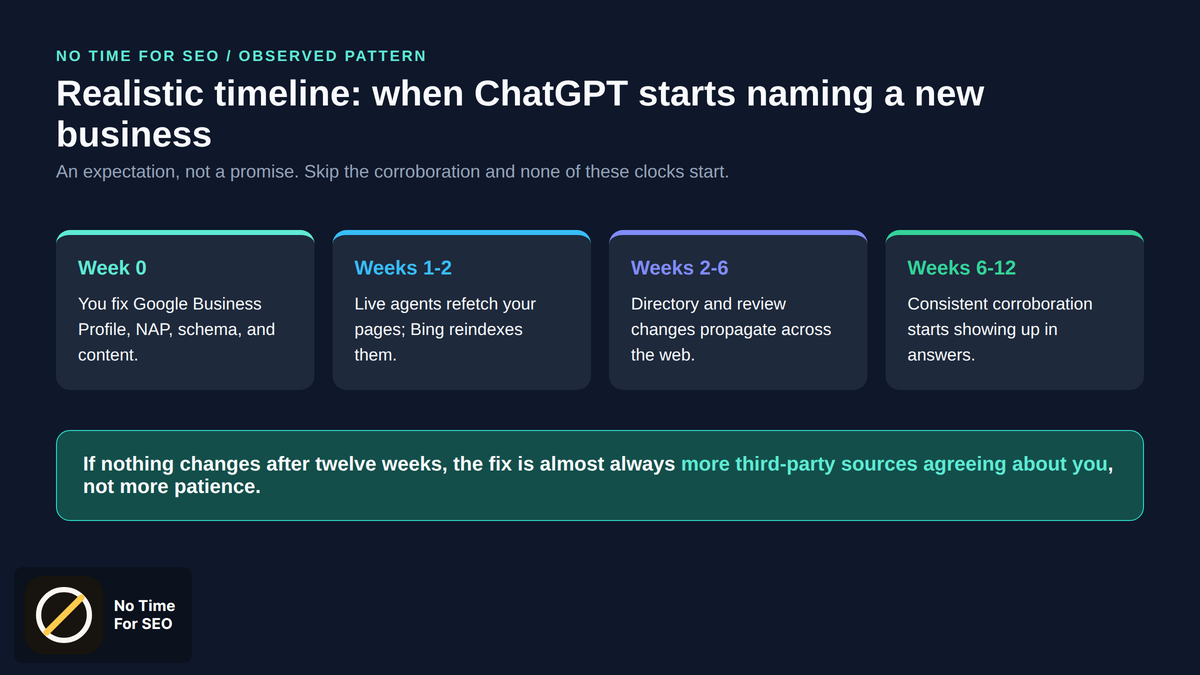
    The timeline below is a realistic expectation, not a promise. It assumes you actually do the work: Google Business Profile, NAP consistency, directory listings, reviews, schema, and a few third-party mentions. Skip the corroboration and none of the clocks below start.

    A realistic expectation for when a new business starts surfacing in ChatGPT, based on No Time For SEO’s observed pattern.
    Timeframe What is happening
    Week 0 You fix Google Business Profile, NAP, schema, and content.
    Weeks 1 to 2 Live agents refetch your pages; Bing reindexes them.
    Weeks 2 to 6 Directory and review changes propagate across the web.
    Weeks 6 to 12 Consistent corroboration starts showing up in answers.

    Takeaway: plan for a six to twelve week horizon, and if nothing has changed after that window, the problem is almost always too few third-party sources agreeing about you, not a delay.

    What to do if nothing changes after weeks of effort

    Rerun the prompt test, then check the corroboration. Are you on the main directories with identical NAP? Do you have detailed reviews naming the service and city? Are there any mentions off your own domain at all? Missing corroboration, not patience, is the usual fix.


    Traditional SEO versus generative and answer engine optimization

    Traditional SEO earns clicks from a ranked list; generative and answer engine optimization earns a mention inside a written answer. GEO (generative engine optimization) and AEO (answer engine optimization) are two names for the same goal: being the source an AI quotes.

    How optimizing to be mentioned in ChatGPT differs from optimizing to rank on Google.
    Dimension Traditional SEO GEO / AEO
    Goal Rank in the list of links Be named in the answer
    Unit of success A click A citation or mention
    Key signal Links and rankings Corroboration across sources
    Content shape Keyword-optimized pages Extractable, direct-answer statements
    How content is read Crawled and indexed Fetched live at answer time
    Tip: The good news for owners is that clean SEO fundamentals and GEO overlap heavily, so a verified Google Business Profile, consistent NAP, and clear content help you rank and get mentioned at the same time.

    Strong fundamentals compound on the open web ChatGPT reads. A trading-education platform we run search for has 82 of its top 100 keywords on page one of Google, and 63% of its clicks are non-branded, measured across the top-100 query sample for the 28-day window ending July 12, 2026. The same footprint that wins those rankings is what AI systems read when they answer.


    The same fixes largely work for Claude, Gemini, and Perplexity

    The corroboration you build for ChatGPT also helps Claude, Google’s Gemini and AI Overviews, and Perplexity, because they all reward the same thing: a consistent, well-covered public record. They are different systems that behave differently, so a mention in one does not guarantee a mention in all.

    How ChatGPT, Claude, Perplexity, and Google AI Overviews source answers, with our crawl counts for the week of Mon Jul 6, 2026.
    System Where it mainly sources answers Its crawler in our logs that week
    ChatGPT Live web via Bing’s index, read at answer time chatgpt-user: 8,672 live fetches
    Claude Its own crawl plus live web ClaudeBot: 6,607
    Perplexity Live web with sources cited visibly PerplexityBot: 711
    Google AI Overviews Google’s own index and local data Googlebot (not in this AI-agent sample)

    Takeaway: do not lump these systems together, because ChatGPT leans on Bing’s live index while Google AI Overviews lean on Google’s own index and established local data, and the exact behavior differs even though the underlying fixes overlap.

    Tip: Run your five test prompts in ChatGPT, Perplexity, and Google’s AI Overviews on the same day. Where you appear in one but not another tells you which corroboration source that system is missing.

    Where these numbers come from

    Every number in this guide is measured, not modeled. Here is the provenance so you can weigh it honestly.

    • Crawler figures: raw nginx server logs across the 8 business sites No Time For SEO tracks, matched by user-agent (GPTBot, ClaudeBot, PerplexityBot, chatgpt-user, and others) and aggregated for the week of Monday July 6, 2026.
    • Google figures: each client’s Google Search Console page and query reports, verified in July 2026 over a 28-day window, with client names kept anonymous and full data available on request.

    These are what we measured on the sites we manage. They are honest scope, not a guarantee of your results.


    Your do-this-now checklist for this week

    Run this in order. Each step is something a busy owner can finish without a marketing team, and together they build the corroboration ChatGPT looks for.

    1. Run the five test prompts in ChatGPT with web search on and save the answers with today’s date.
    2. Write your one-sentence entity statement and put it on your homepage and Google Business Profile.
    3. Claim and complete your Google Business Profile, with the exact category and matching NAP.
    4. Fix NAP everywhere: make name, address, and phone identical across every directory and listing.
    5. Paste the LocalBusiness schema onto your site and validate it in Google’s Rich Results Test.
    6. Rewrite your homepage and top service page to lead with plain, extractable answer sentences.
    7. Ask three recent happy customers for a review that names the service and the city.
    8. Get one new third-party mention: a directory listing, a roundup pitch, or a local press note.
    9. Read our companion notes on getting found in AI search and pick your next mention target.
    10. Rerun the five prompts in six weeks and compare, then in twelve weeks again.

    Full disclosure in one sentence: No Time For SEO does this work for clients, which is why we have server logs and Search Console data to share, and the playbook above is the same one we run.


    Frequently asked questions

    Can I pay ChatGPT to mention my business?

    No, you cannot pay OpenAI to have ChatGPT recommend your business in organic answers. There is no ads slot inside a normal recommendation. Visibility comes from corroboration: a verified Google Business Profile, consistent NAP, reviews, schema, and third-party mentions that agree about what you do.

    Does blocking AI crawlers hurt my ChatGPT visibility?

    Blocking chatgpt-user in your robots.txt or firewall can stop ChatGPT from reading your pages live to answer questions, which is the exact fetch that gets you mentioned. Blocking GPTBot only opts you out of future training crawls. If you want ChatGPT mentions, do not block chatgpt-user.

    How do I check if ChatGPT is reading my website?

    Check your server access logs for the user-agents chatgpt-user, GPTBot, ClaudeBot, and PerplexityBot. A chatgpt-user hit means ChatGPT fetched that page live to answer someone. Across the 8 sites No Time For SEO tracks, chatgpt-user made 8,672 such fetches in the week of July 6, 2026.

    Is getting mentioned in ChatGPT different for a local business than a national brand?

    Yes. National brands often already sit in ChatGPT’s training data, so they appear without live search. A local business is won on Google Business Profile, NAP consistency, local directories, and reviews, which is where a solo owner can act fastest and see change in weeks, not years.

    What is the single most important step to get mentioned in ChatGPT?

    Build third-party corroboration: get described the same way across your Google Business Profile, directories, reviews, and at least a few mentions off your own domain. ChatGPT names businesses it can verify from more than one independent source, so agreement across the web is the single most effective move.

    Will these fixes also help me show up in Google AI Overviews and Perplexity?

    Largely yes, because Google AI Overviews and Perplexity reward the same consistent, well-covered public record. They are different systems with different behavior, so test each separately, but the underlying work of clear entity data, reviews, schema, and third-party mentions overlaps heavily across all of them.